How Pre-Alcohol works
It takes two enzymes to clear alcohol. Your gut only makes one.
That gap is where acetaldehyde piles up. A team of microbiologists spent years engineering a bacterium to close it.
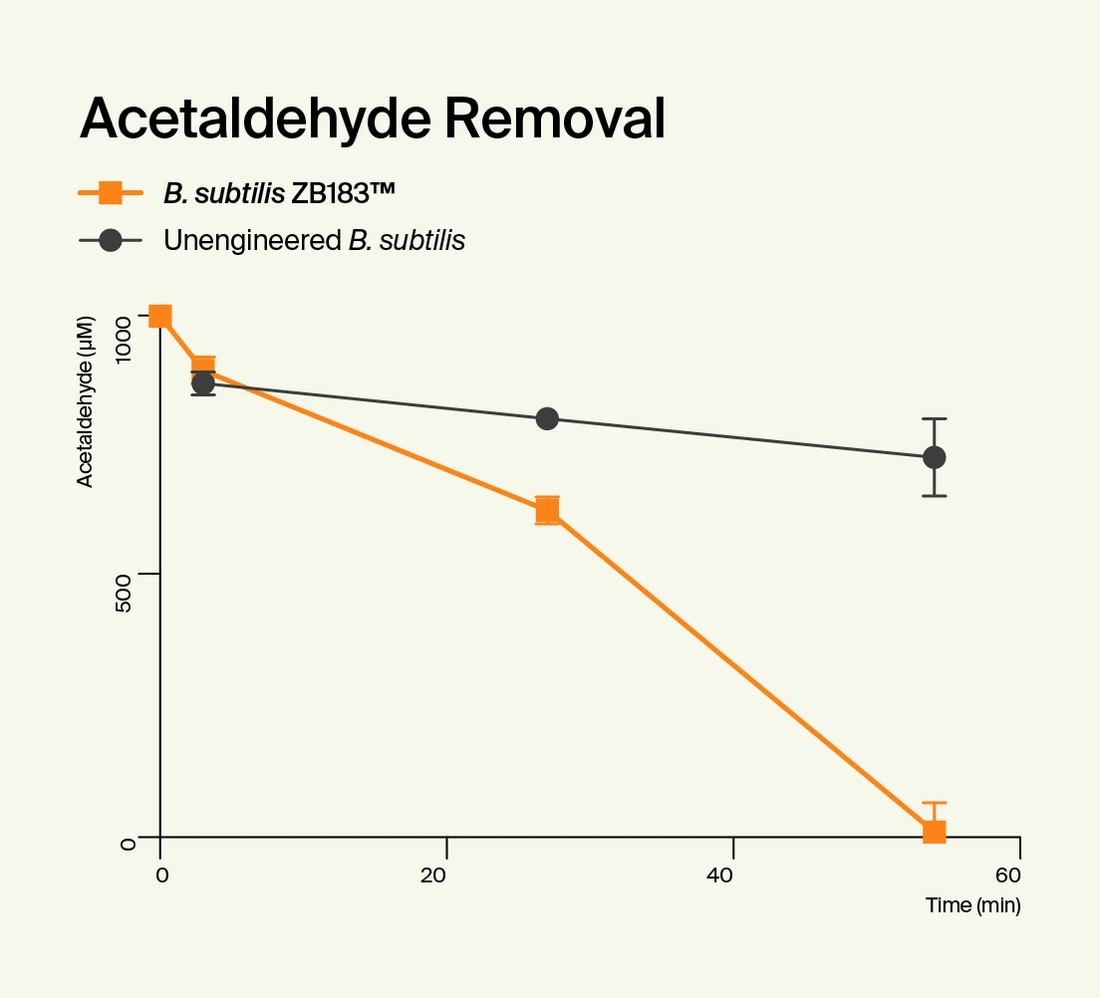
Read that chart again and the whole product makes sense. Two versions of the same ordinary bacterium sit in the same solution. One of them clears the acetaldehyde in under an hour. The other, the one nature made, barely touches it. The difference between those two lines is one gene, and that gene is the entire reason ZBiotics Pre-Alcohol exists.
Almost nobody gets there. Most people meet this product as a small black box on a shelf, read the words genetically engineered probiotic, file it somewhere between kombucha and science fiction, and move on. Which is a shame, because unlike most things sold near a liquor aisle, this one has a mechanism you can actually follow. It fits in about eight minutes.
So here it is, start to finish: what your body does with a drink, where the process stalls, why you cannot fix it by swallowing a pill, and what a microbiologist did about it after twelve months in a rented Berkeley lab.
Step one
Alcohol leaves your body in two moves, not one
Your body does not simply flush alcohol out. It dismantles it, in two chemical steps, and each step needs its own enzyme.
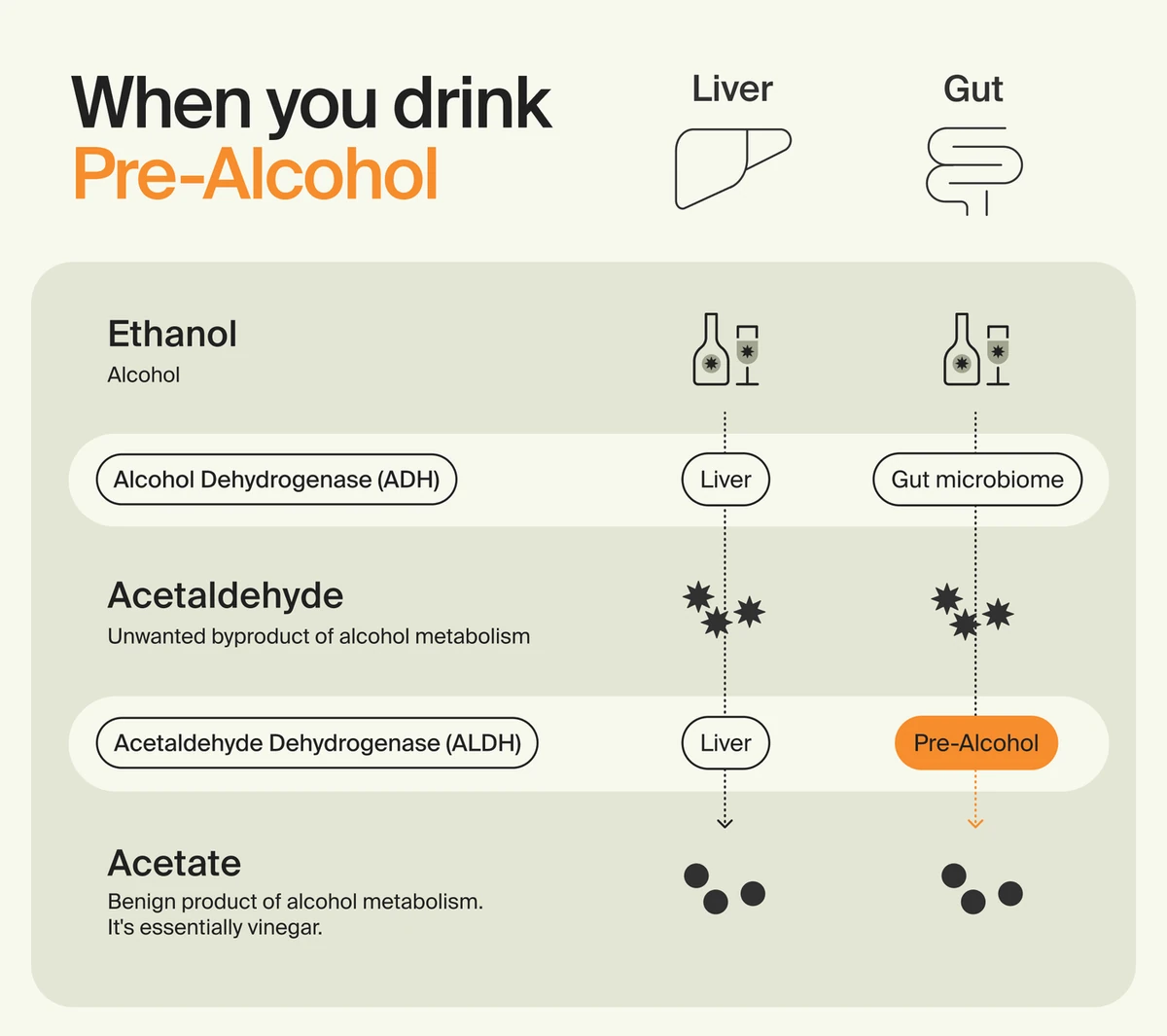
Step one. An enzyme called alcohol dehydrogenase, ADH, converts ethanol into a compound called acetaldehyde. Acetaldehyde is the problem child of this story. ZBiotics describes it as an unwanted, toxic byproduct, and notes that its chemical structure is highly reactive, which means it can interact with a whole host of molecular and cellular components throughout the body.
Step two. A second enzyme, acetaldehyde dehydrogenase or ALDH, converts that acetaldehyde into acetate. Acetate is harmless. In ZBiotics' own words on their science page, it is essentially vinegar.
In your liver, both steps run. ADH turns the ethanol into acetaldehyde, ALDH turns the acetaldehyde into acetate, and the acetaldehyde barely exists long enough to matter. ZBiotics puts it plainly: almost none of the acetaldehyde your body is exposed to is initially formed in the liver.
Which raises the obvious question. If the liver handles it that cleanly, where is all the acetaldehyde coming from?
Step two
Most of it never reaches your liver at all
Follow a drink through the body and the liver turns out to be the fifth stop, not the first.
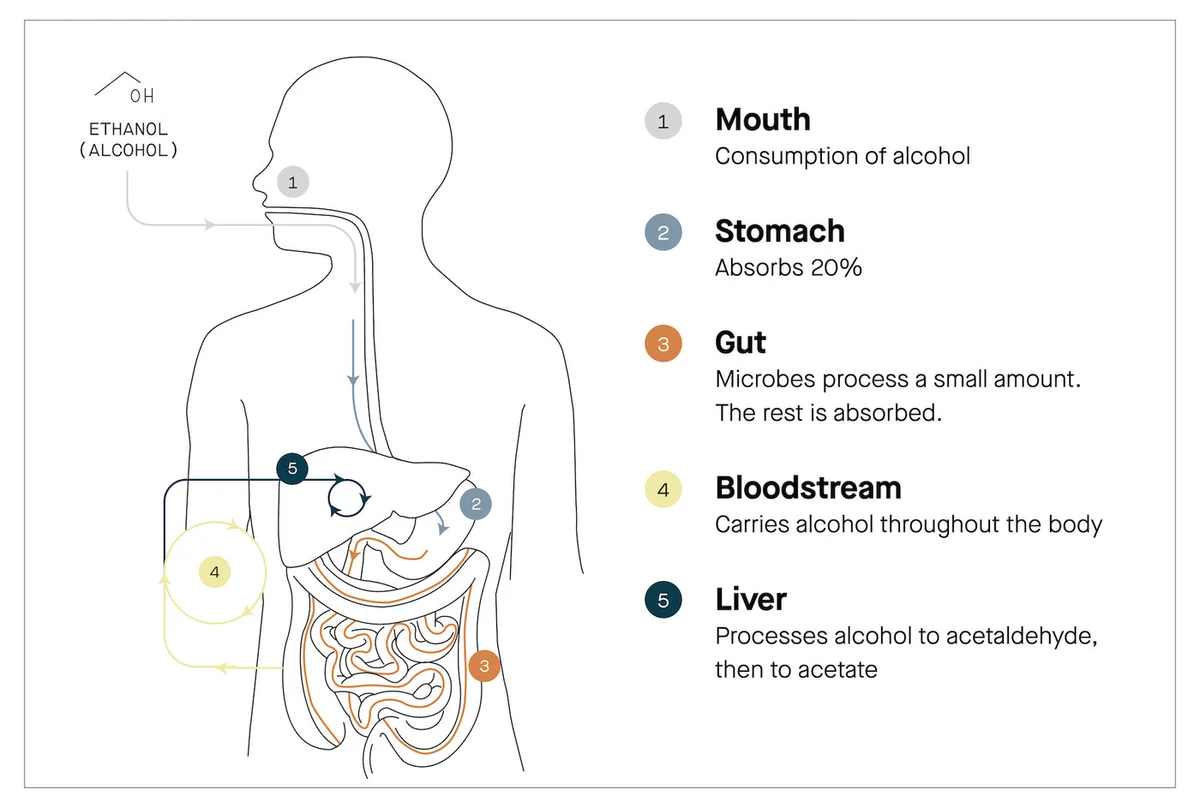
It starts in the mouth. About 20 percent is absorbed straight through the stomach lining, which is why drinking on a full stomach slows everything down. Then it reaches the gut, where most of the rest is absorbed through the intestinal lining, and where something else happens first.
Your gut is not sterile. It holds a dense population of microbes, and a small share of the alcohol you drink gets metabolized by them before it is ever absorbed. Those microbes carry the first enzyme, ADH. They convert alcohol into acetaldehyde perfectly well.
What they are not equipped to do, in ZBiotics' phrasing, is efficiently produce the second enzyme. So the breakdown stalls at step one, and acetaldehyde builds up exactly where it was made.
How much higher acetaldehyde concentrations can get in the gut than in the rest of the body when you drink, according to ZBiotics' science page.
Acetaldehyde is highly soluble, so it does not stay put. It is absorbed out of the gut and into the bloodstream.
This is the sentence the whole product rests on, and it is a little counterintuitive, so it is worth reading slowly. The gut is a minor site of alcohol breakdown compared to the liver. It handles a small fraction. But because it only performs half the reaction, that small fraction ends up being, in ZBiotics' words, the major source of acetaldehyde in the body.
Which gives you a clean hypothesis, and it is exactly the one ZBiotics states on their site: if you can equip the gut microbiome to break down acetaldehyde into acetate, you can support the body's ability to minimize the buildup of that byproduct. The liver is already fully capable. The gut is the gap.
Step three
Why you cannot fix this with a pill
The obvious move is to make a lot of ALDH, put it in a capsule, and swallow it. Copy the liver. It does not work, and the reason is boring and absolute.
Enzymes are proteins. Proteins are what your stomach is built to take apart. Swallow an enzyme and it gets treated like any other piece of food: broken into fragments, and a fragmented enzyme does nothing at all. ZBiotics notes that only a handful of enzymes are even remotely stable enough to survive that trip, lactase in lactose intolerance products being one of the rare examples.
Swallow the enzyme
Digested
A protein taken by mouth is broken down in the stomach like food. Once broken down, it loses its function.
Send something that makes it
Delivered
A bacterium that survives stomach acid can produce the enzyme continuously, in the place where it is needed.
So the problem changes shape. You are no longer looking for a molecule to swallow. You are looking for a courier: something that survives the stomach, arrives in the gut intact, and manufactures the enzyme on site for as long as it is there.
Bacteria do this for a living. ZBiotics calls engineered probiotics tiny living factories, engineered to continually produce and deliver a specific set of proteins and enzymes right where they are needed in the body.
Step four
The courier is a bacterium you have almost certainly eaten
They did not invent a new organism. They started with Bacillus subtilis, one of the most studied probiotic species in the world, which humans have been eating on purpose for centuries in fermented foods like natto and kombucha.
Three properties made it the right chassis, and all three are on ZBiotics' science page:
- It survives your stomach. B. subtilis passes through stomach acid unharmed and makes enzymes once it reaches the gut.
- It does not move in. It is well adapted to passing straight through rather than colonizing. ZBiotics designed the product specifically so it would not change your microbiome.
- It is naturally editable. It takes up DNA from its environment on its own, a state called competence, and integrates it precisely. That is not a lab trick, it is how the species has traded genes for billions of years.
Step five
The edit itself, in two natural steps
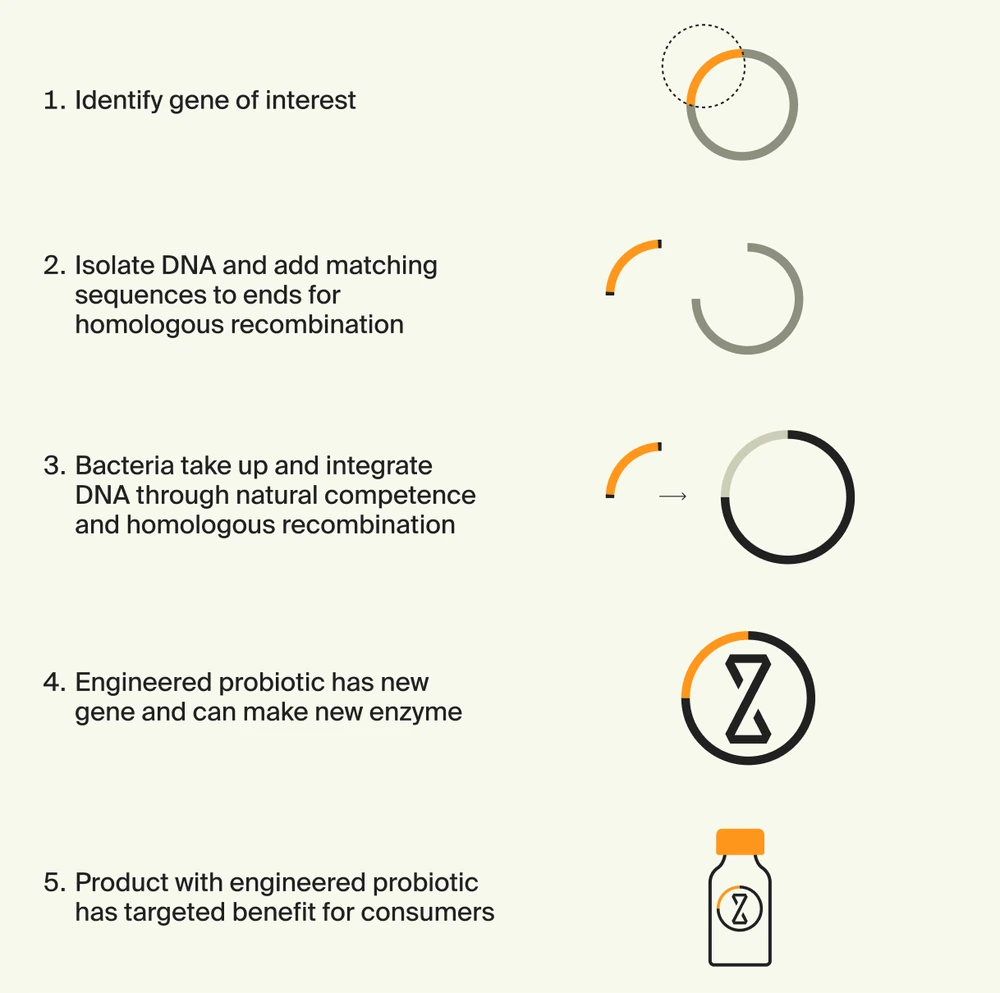
Here is the part people brace for, and it is calmer than the phrase genetically engineered suggests. There is no CRISPR involved. ZBiotics says so explicitly, and explains why: CRISPR is not necessary for what they are doing.
Instead they use two processes the bacterium already performs by itself.
Natural competence
Some bacteria periodically enter a state where they take up loose DNA from their surroundings. B. subtilis does this naturally, so at any moment a subset of any population is ready to accept new genetic material.
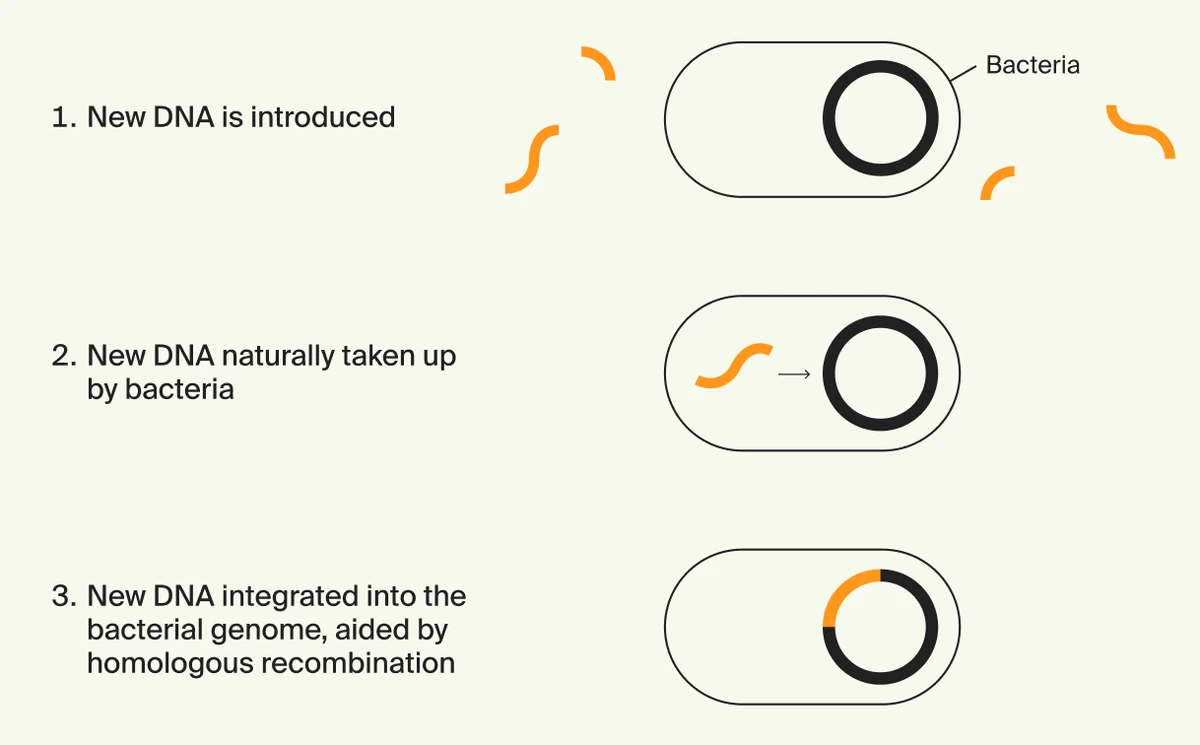
Homologous recombination
Once the DNA is inside, the cell looks for matching sequences between the new fragment and its own genome, then swaps the section out. ZBiotics compares it to a highly precise find and replace in a word processor. Design the new DNA with matching bookends on each end and the bacterium files it in exactly the right place, by itself.
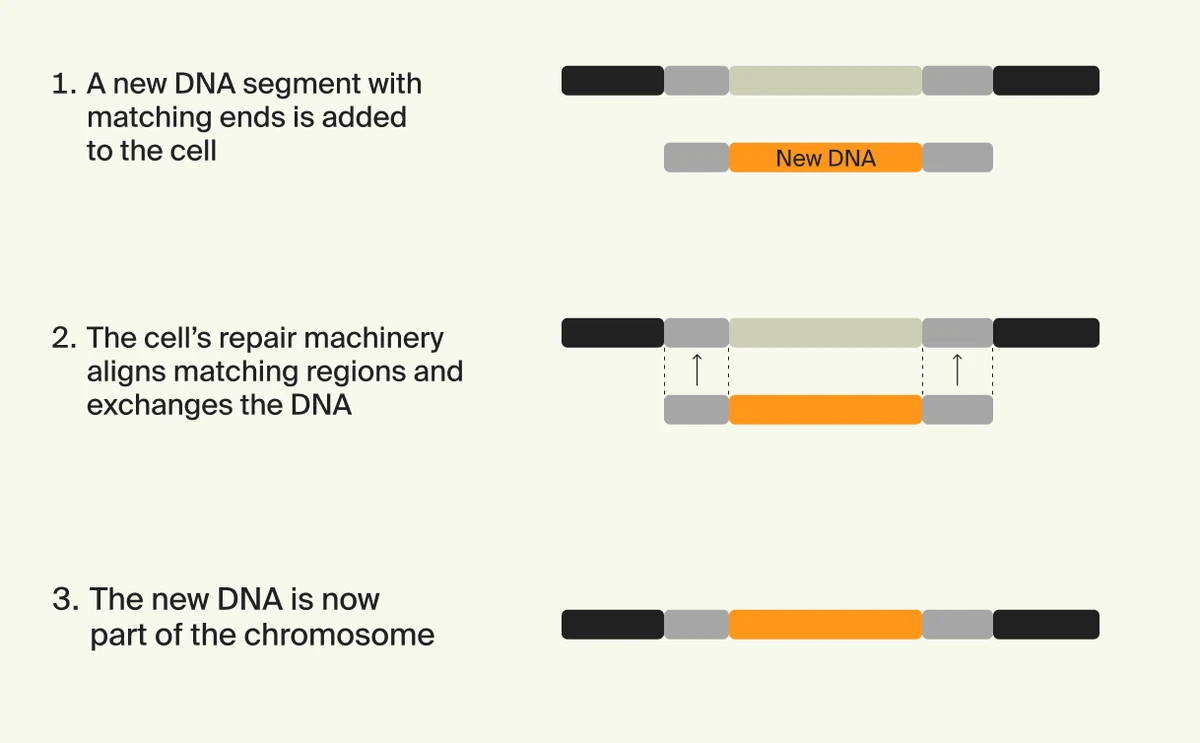
The gene they inserted carries the instructions for ALDH, the second enzyme, the one your gut microbes fail to make in useful quantities. The result is Bacillus subtilis ZB183: identical in every way to the strain humans already consume, with one trait added.
Things this does not do
ZBiotics answers three questions directly on their genetic engineering page. It does not interact with your DNA in any way, because the probiotic works in your digestive system and never enters your cells. It does not colonize your gut or permanently alter your microbiome. And they verify the strain's genome with next generation sequencing to confirm that only the intended change is present.
Step six
Does it actually work in a tube?
That is the right question to ask about any mechanism, and it has a published answer. Back to the chart at the top of this page, now with a third condition.
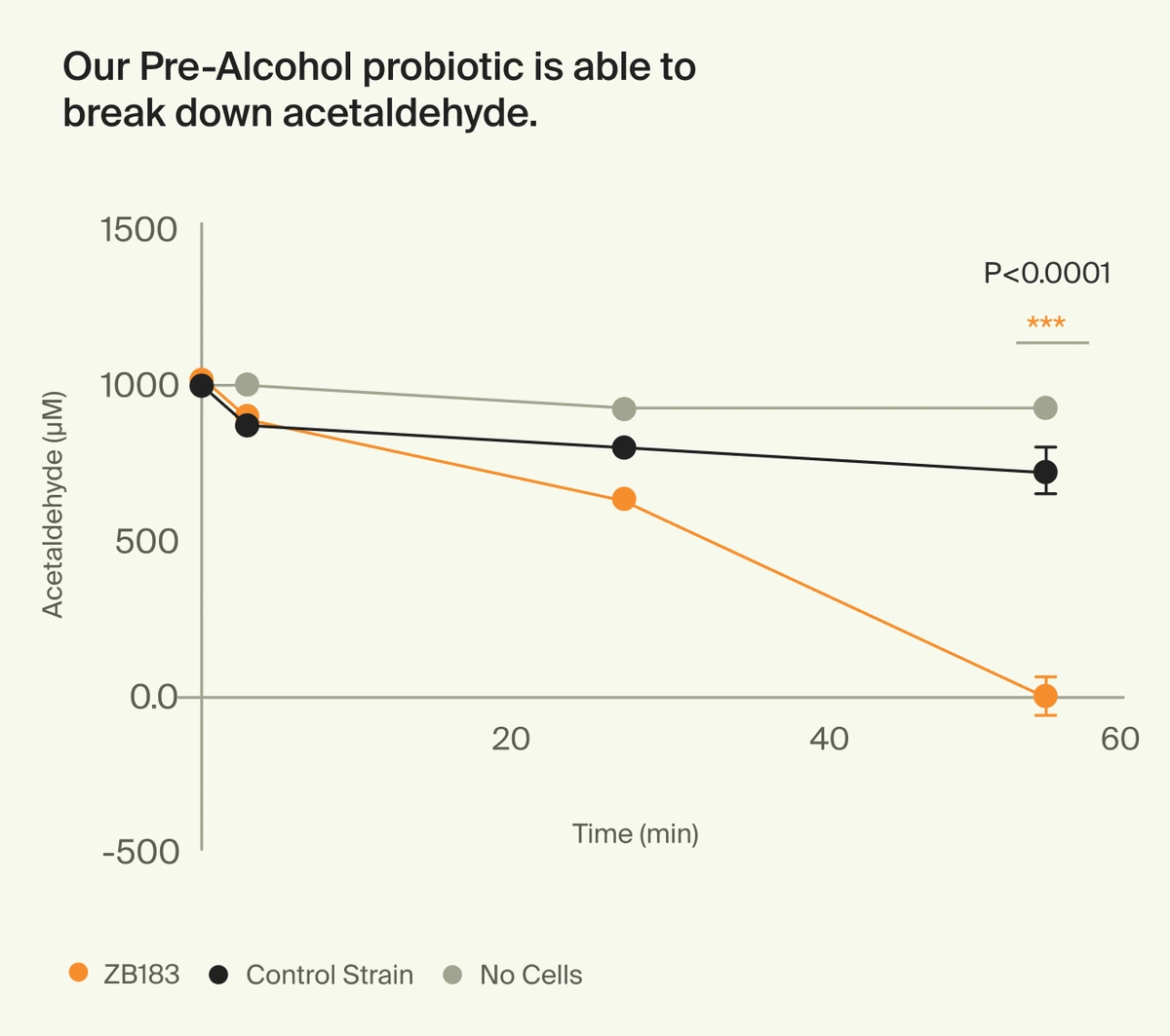
The blank barely moves, as you would expect from a tube with nothing in it. The unedited parent strain barely moves either, which is the real point: this is not something ordinary probiotics quietly do. Only the edited strain drives acetaldehyde down, and it reaches the floor inside an hour.
ZBiotics summarizes the result on their site as being able to break down more acetaldehyde than you could ever encounter when drinking.
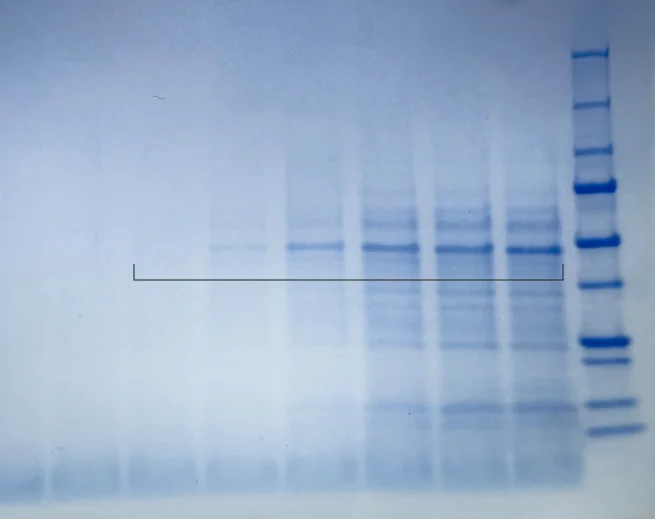
The enzyme itself is visible too. During validation they run a protein gel, where each lane is a different point in the bacterium's growth and a darkening band shows the engineered protein accumulating over time.
The paper trail
- Function. The acetaldehyde breakdown data was published in the peer reviewed journal PLOS One.
- Safety. Years of laboratory testing, reviewed by an independent panel of food toxicologists, published in the peer reviewed Journal of Toxicology.
- Patent. The US Patent Office issued ZBiotics patent US10849938B2 in January 2021, covering both the gene expression system and a microbe engineered to break down acetaldehyde.
- Every batch. ZBiotics publishes its testing standards, including an ALDH activity target of more than 9 nmol NADH per minute per mg of total protein, tested on every single batch.
Step seven
What that means when you actually drink one
Put the pieces together and the product stops being mysterious. You drink a 0.5 ounce bottle. The spores travel through your stomach intact, wake up in your gut, and start producing ALDH. Then you have your drink, your gut microbes do what they always do and produce acetaldehyde, and this time the second enzyme is there to meet it.
That is the entire claim. It is narrow on purpose, and the company is unusually strict about its edges.
What Pre-Alcohol does not do, in ZBiotics' own words
- It does not affect how drunk you get. It does not decrease your blood alcohol level, nor does it make alcohol any safer.
- It does not cancel the rest of a night out. Alcohol will still probably affect your well being and your sleep.
- It does not change your microbiome. That was a design decision, not a side effect.
- It does not touch your DNA. The probiotic never enters your cells.
- It is not FDA approved. It is FDA compliant for safety, which is a different thing. Approval is a process reserved for drugs.
- It does not work for everyone. ZBiotics' research shows about 5 percent of people see no benefit, largely due to individual differences in biology.
That last one deserves its own paragraph, because most companies would have buried it. ZBiotics wrote an entire article explaining who the product is likely to fail. Roughly 8 percent of people worldwide carry a genetic variant that impairs the liver's own ability to break down acetaldehyde. For them the liver, not the gut, is the main source of buildup, and a product that works in the gut is not built to help. Everyone's microbiome is also different, and an unusual gut environment may not support the probiotic activating as expected.
Their answer to that is a 100 percent money back guarantee, stated plainly: for anyone in that 5 percent, reach out and they will provide a full refund.
And their safety language stays intact throughout. All the same rules about alcohol apply. Do not get behind the wheel, do not operate heavy machinery, and do not drink too much.
Step eight
Why the first drink of the night
The timing follows from the mechanism. The probiotic needs a moment to wake up in your gut, so the enzyme is being produced before the acetaldehyde shows up rather than after. ZBiotics' own guidance is the earlier the better.
-
Before the first drink
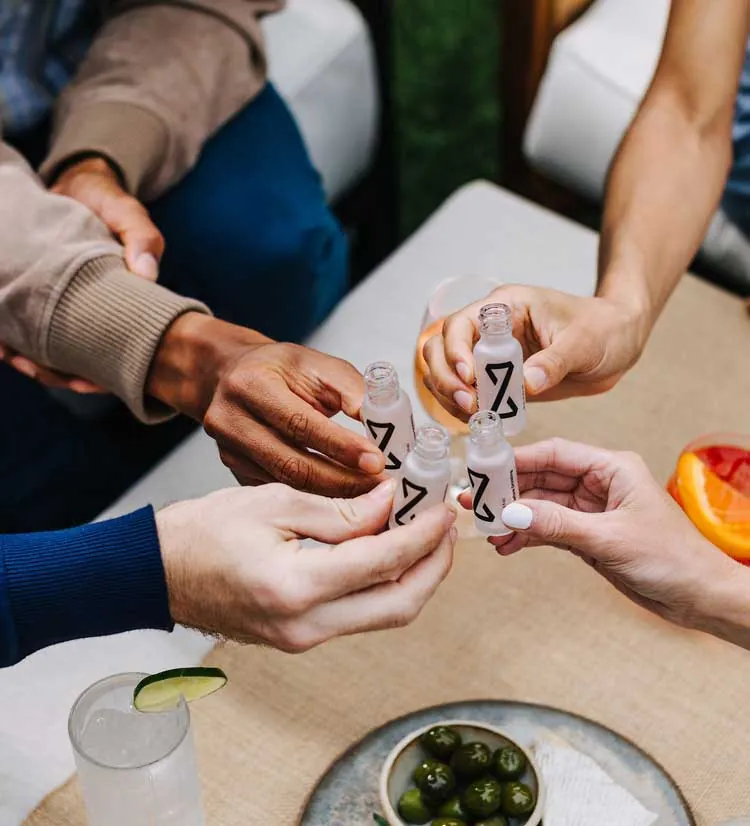
One 0.5 ounce bottle. ZBiotics says they drink theirs just before going out, right before the first drink of the night.
-
Through the evening
The spores germinate and the engineered strain produces ALDH in the gut while your microbes are producing acetaldehyde.
-
Overnight
The probiotic is likely to stay in your body for 18 to 24 hours, so one bottle covers a full day, brunch mimosas through evening plans.
-
Missed the moment?
A few hours before, with your first drink, or even after a round or two. ZBiotics says go for it either way.
Free US shipping. 100 percent money back guarantee.
Step nine
Who built it
The technology was developed in house, by the company's own scientists, in the company's own microbiology lab. That is unusual enough in this category to be worth stating.
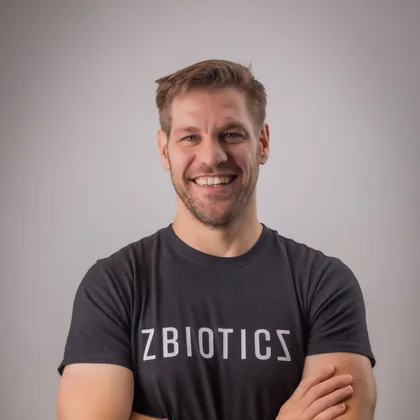
Dr. Zack Abbott
Founder, CEO, and inventor of the technology behind Pre-Alcohol. PhD in Microbiology and Immunology from the University of Michigan, where he trained under Professor Michele Swanson, a former President of the American Society for Microbiology.
The founding story ZBiotics publishes is not a polished one. Abbott rented lab space in Berkeley in 2016 and spent the next twelve months in it, living 90 minutes away in Sacramento and sleeping on the floor beside his bench so his experiments could keep running around the clock.
He had a list of dozens of ideas for what an engineered probiotic might do. He pitched them to friends and family, and one came back louder than the rest: a microbe that breaks down the byproduct of alcohol. In April 2017 he walked out of that lab with what would become the world's first genetically engineered probiotic.
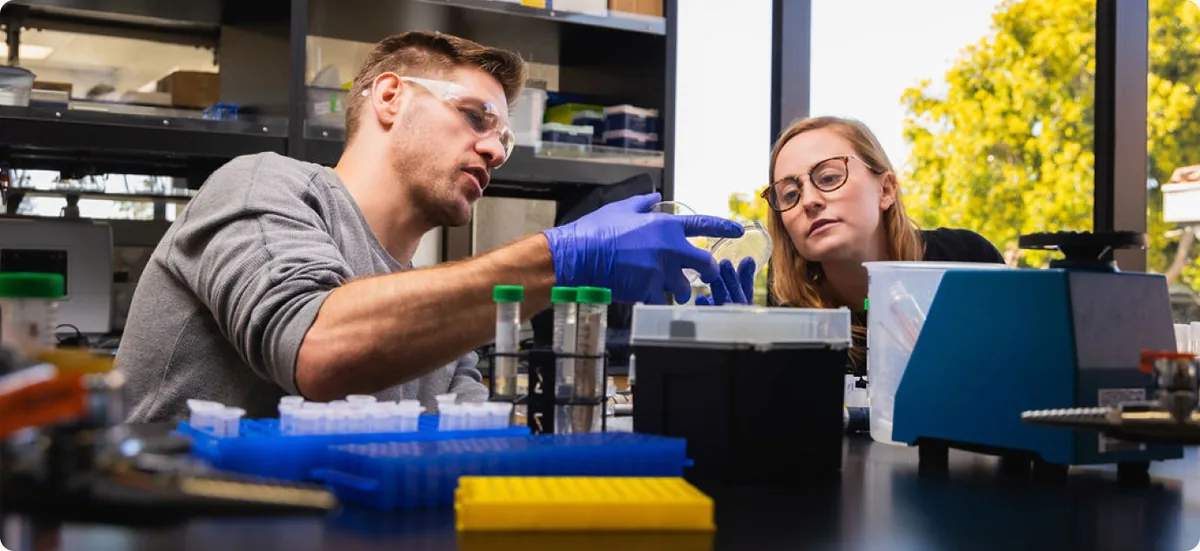
Then came the part nobody plans for. He and co-founder Stephen Lamb moved the lab to San Francisco, and three days a week drove crates of fresh vials down the peninsula by hand to anyone who would take one. Abbott could make 200 samples every 36 hours. Requests started arriving hourly. They joined Y Combinator in January 2018, and in August 2019, three years after that first rented bench, Pre-Alcohol launched.
It was the first genetically engineered probiotic ever brought to market. The label says Proudly GMO, which in an aisle papered with non-GMO badges is either a marketing mistake or the entire point.
Step ten
What people say after they try it
The reviews on ZBiotics' own product page follow a pattern that is hard to fake, and it is the pattern this whole article predicts: people arrive skeptical, and the ones it works for find out by forgetting it once.
"I was convinced that this didn't work, until the day I didn't take it. Now it's my go-to pregame shot."
Victor, Eastvale, CA · published on zbiotics.com"I'm usually skeptical of supplements doing what they claim, but this one works, so I've bumped up the frequency of my order."
Neil, San Francisco, CA · published on zbiotics.com"It was a lifesaver at my bachelor party and it was a life saver at my wedding. You should have seen the look on my groomsmen's faces when I pulled out a fresh box of ZBiotics."
Christopher, Denver, CO · published on zbiotics.comAnd because the 5 percent is real, here is one from the other side, published on the same page, unedited:
"Not sure if it actually works. I have taken it 3 times prior to drinking, and I don't feel any differences."
Sangjoon P., 2 out of 5 · published on zbiotics.comZBiotics' public rating sits at 4.2 out of 5 across 2,219 reviews, with 1,450 verified five star reviews. That is a real distribution rather than a perfect one, which is roughly what a product with a narrow, honest mechanism should look like.
Step eleven
What is in it, and what it costs
The ingredient list is five lines long: water, natural flavors, potassium sorbate, sodium chloride, and Bacillus subtilis ZB183. No sugar, no caffeine, no vitamin blend. It is gluten free, nut free, dairy free, sugar free, shellfish and fish free, vegan friendly and third party tested.
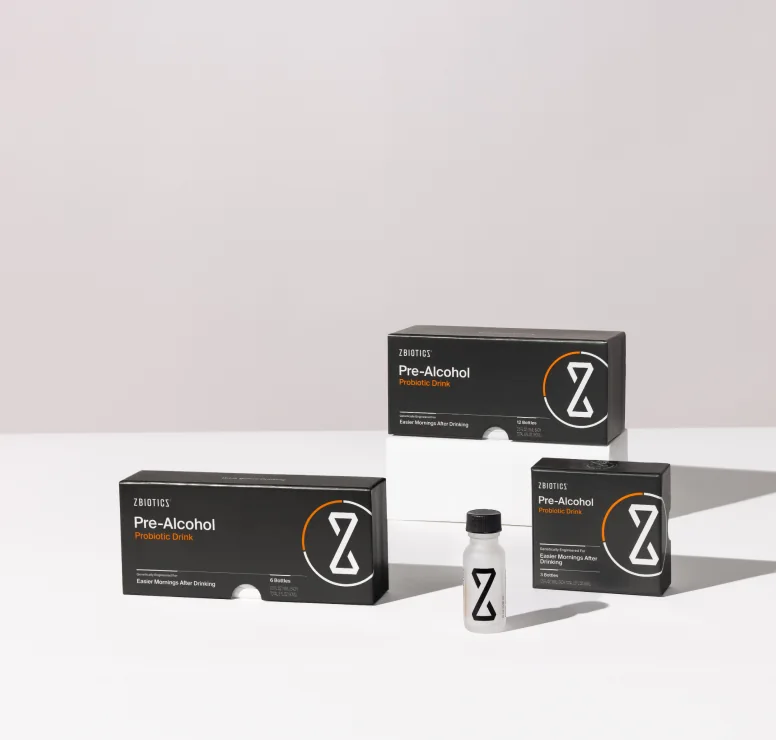
| Pack | Price | Per bottle |
|---|---|---|
| 3-pack | $36 | $12 |
| 6-pack | $60 | $10 |
| 12-pack | $108 | $9 |
Prices as published on zbiotics.com. A monthly subscription saves a further 20 percent and can be cancelled anytime. Bulk packs of 50 and 100 are also listed. Shipping in the US is free.
Storage is simple and worth knowing: room temperature with the cap on, do not refrigerate, and do not open the bottle until you are ready to drink it. It expires 18 months after bottling, and the date is printed on the bottle and the box.
From $9 a bottle. Free US shipping. 100 percent money back guarantee.
The short version
Clearing alcohol takes two enzymes. Your liver makes both. Your gut makes the first one and stalls, which is why the gut ends up being the largest source of acetaldehyde in the body even though it processes the smallest share of the alcohol.
You cannot swallow the missing enzyme, because your stomach digests it. So a team of microbiologists took a bacterium people have eaten for centuries, used the bacterium's own DNA handling machinery to add the gene for that enzyme, published the safety and the function in peer reviewed journals, and put it in a bottle you drink first.
It will not make you less drunk, it will not fix your sleep, and for about one person in twenty it will do nothing at all. Everything else about it is just chemistry running one step further than it usually does.
Please drink responsibly. 21+.