Precision nutrition
A test hands you a score. A plan hands you a grocery list.
What the four Viome food lists actually say, and why spinach lands on the wrong one for most people.
Most at-home health tests end the same way. A screen of numbers, a few of them red, and a paragraph telling you to eat more fiber and manage your stress. You paid a few hundred dollars to be told what you already suspected.
The interesting question is the one that starts the morning after. Not what is wrong. What, exactly, goes in the cart on Saturday.
That gap between a result and a decision is the whole argument for a personalized food plan, and it is also the part almost nobody shows you before you buy. So here is the inside of one: the four lists, the rule attached to each, the score that decides which list a food lands on, and what the first thirty days look like when you actually follow it.
01 The four listsEvery food you eat gets sorted into one of four buckets, and each bucket is an instruction
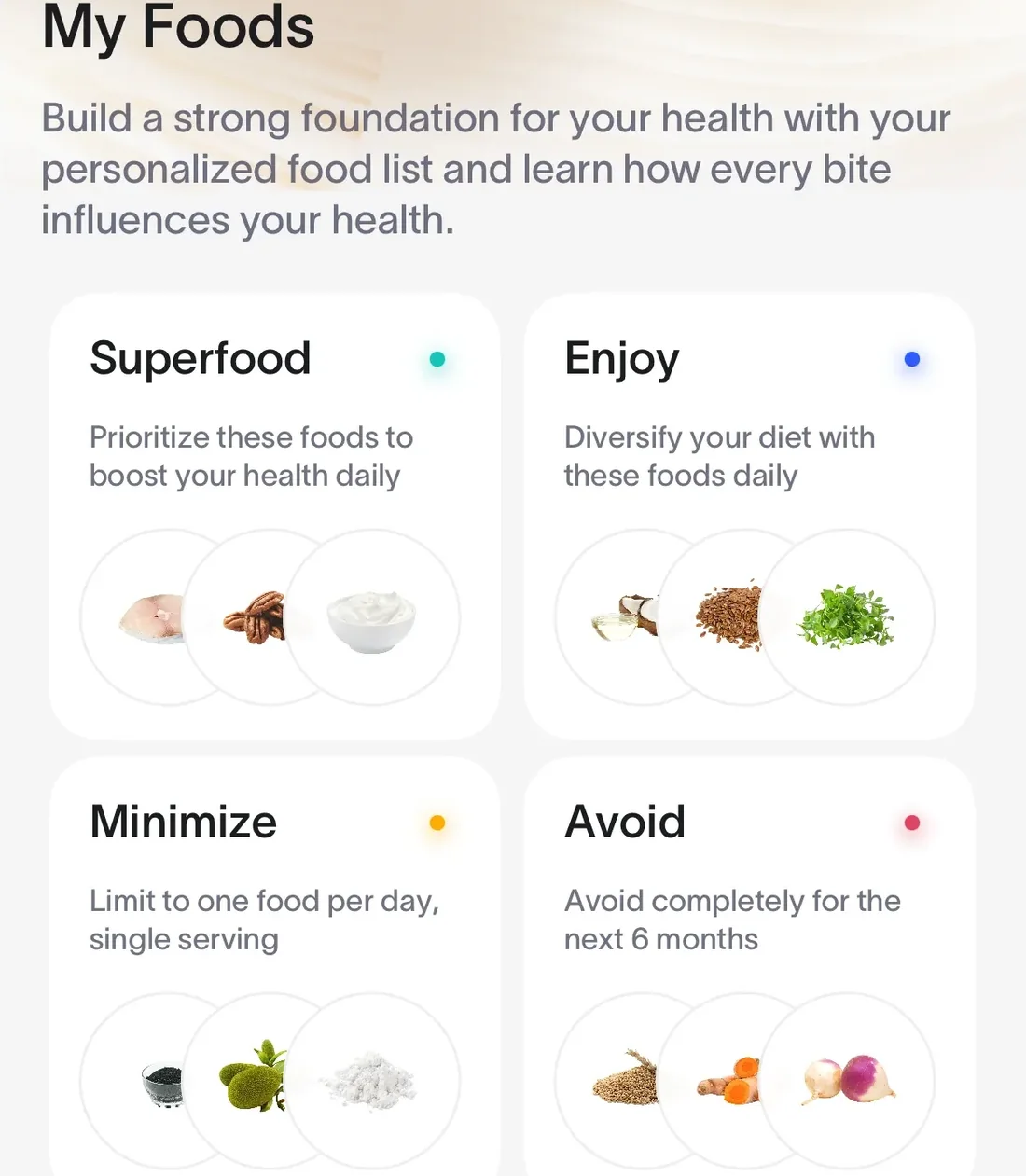
When Viome results land, the food database is not returned as a score. It is returned as four lists. Viome publishes what each one means and how it is meant to be used, and the wording matters, because the difference between a suggestion and a plan is whether there is a number attached.
Viome calls these the foods your microbiome loves right now, matched to what your current scores say your body is short of. Their published guidance: include at least one in every meal, keep them stocked, and introduce unfamiliar ones gradually.
Everyday staples that work with your current microbial composition. Not targeted the way a superfood is, but safe to build meals around. Viome describes these as the foundation of your meal planning.
Not banned. Not optimal either. Viome's rule is one to two foods from this list per day at most, never several in the same meal, and pay attention to how you feel afterwards.
Foods identified as creating a disruption given your current biology. The practical advice is unglamorous and specific: keep the list on your phone at the store, read ingredient lists, ask at restaurants, and replace them from the two lists above.
Read those four rules again as instructions rather than categories. One food per day, single serving. Nothing for six months. That is not a diet philosophy. That is something you can execute on a Tuesday without thinking about it, which is the only kind of nutrition advice that survives contact with a real week.
Food and supplements help your body function and repair itself, but no two people react to all food and supplements the same way. Viome, Understanding Your Viome Food Categories
And the six month clock is not decoration. It is the retest interval. The avoid list is written to expire.
02 How a food gets sortedSpinach is the clearest case, because for most people it does not end up where you would expect
Take the most photographed vegetable in wellness. Viome ran the numbers on 10,000 of their own customers and looked at where spinach landed on each of their food lists.
Close to 60% were told to avoid or minimize it.
Figures published by Viome in their own analysis of spinach recommendations, viome.com/blog.
Where spinach landed, across 10,000 Viome customers
Viome's own breakdown of spinach recommendations in that sample.
Viome reports close to 60% of that population in the avoid or minimize categories. The remainder is split between superfood and enjoy. The vegetable did not change. The people did.
The reason is oxalates. Spinach is one of the highest oxalate foods there is, alongside beet greens, rhubarb, chard and endive. Oxalates have to be broken down in the gut. When the body cannot metabolize them efficiently, urinary oxalate rises, and close to 80% of kidney stones are reported to form from calcium oxalate. Oxalates binding calcium in the gut also blocks the calcium you were trying to absorb.
Here is the part that makes this a plan rather than a warning label. Viome does not decide by looking for one bacterium. They looked: they compared 1,500 people whose plan called spinach a superfood against 1,500 matched people told to avoid it, and the abundance of Oxalobacter formigenes, the textbook oxalate specialist, was not different between the two groups.
What was different was the score. Hundreds of species carry the enzymes that degrade oxalates, so Viome rolls all of that activity into a single number in the app, the Oxalate Metabolism Pathways score, and that number was significantly higher in the superfood group.
One food, two answers
The route a single food takes through the model, as described by Viome.
Two people can hand in the same food preferences and get opposite instructions for the same vegetable, because the second box is not about the food. It is about them.
That is the mechanical answer to a question most people never get answered: why a food list is not a diet. A diet ranks foods. A plan ranks the fit between a food and one body, at one moment.
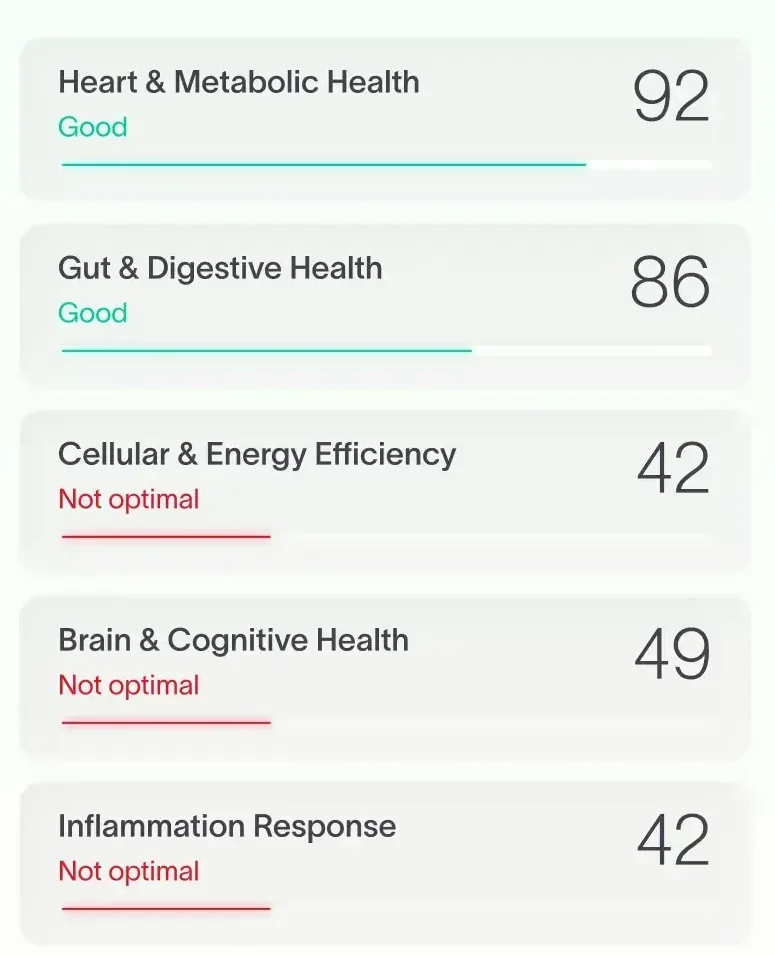
Viome's own scientists took the healthiest lunch on the internet apart, item by item
On Viome's podcast, biochemist Momo Vuyisich, PhD, and Guru Banavar, PhD, ran an exercise worth stealing. They built the meal every wellness feed agrees on, a spinach salad with sliced almonds, a side of roasted broccoli, and a glass of kombucha, then handed over the results of three real Viome tests and asked which parts had to come off each plate.
What the test showed
Very high hydrogen sulfide production
Off the plate Broccoli
Cruciferous vegetables are packed with sulfur bearing glucosinolates, and some gut bacteria convert those straight into hydrogen sulfide.
Swap Asparagus. Similar fiber, similar micronutrients, no sulfur load.
What the test showed
Severe inability to process oxalates
Off the plate Spinach and almonds
Both are among the highest oxalate foods there are, and unprocessed oxalates form crystals that stress joints and kidneys.
Swap Arugula and pumpkin seeds. Same crunch, same vitamin profile, essentially no oxalates.
What the test showed
Immune activation with histamine overload
Off the plate Kombucha
Fermented foods are excellent for many people and fuel on a fire for an inflamed, histamine sensitive gut.
Swap Iced peppermint or ginger tea. Soothing rather than provoking.
Case walkthrough published by Viome, viome.com/blog, "Are There Universal Superfoods?"
Then the number that makes the point land. Run that single plate through the model, Banavar says, and about 20% of the population could not eat it. Not because it is junk. Because it is somebody else's meal.
There's no such thing as a universally healthy food. There's only food that matches your individual biology, or it doesn't match your individual biology. Guru Banavar, PhD, on Viome's podcast, Are There Universal Superfoods?04 Food by food, not food group by food group
The resolution is finer than you expect, and that is where it stops feeling like a diet
A member wrote in to Viome's nutrition team with a question that sounds like a glitch. Almond milk sits on their Enjoy list. Almonds sit on their Minimize list. Where does almond butter go?
The answer is not a rounding error, it is the model working. Making almond milk strips out most of the oxalates, by soaking and straining, by heat, or by adding calcium rich ingredients that bind them. Whole almonds keep theirs. Almond butter is whole almonds, so it follows the nut, not the milk. And because Minimize is not Avoid, the guidance was that a few servings a week are still fine.
The same granularity runs the other direction. Every recommendation carries the reason it was made, and the reason is a pathway, not a food group.
One nut, three answers
Why the same ingredient can sit on two different lists in the same plan.
A food group rule would have put all three in the same bucket. The plan does not work in food groups.
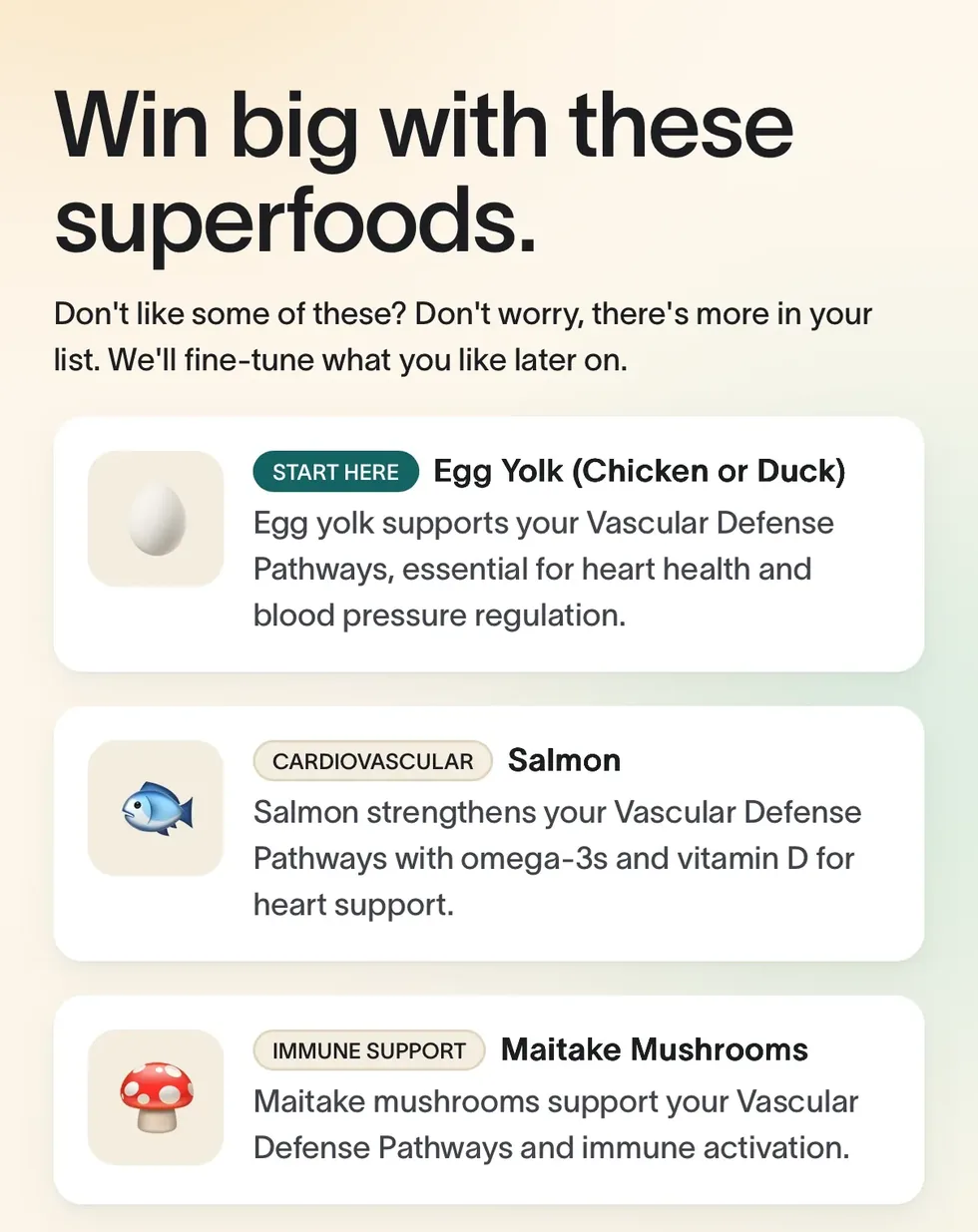
Egg yolk arriving at the top of a superfood list is a small thing that tells you a lot. Nothing in a generic heart health leaflet is going to open with egg yolk. This one did, because the model was not asked what is good for people. It was asked what this person's vascular defense pathways were short of.
05 What the first month looks likeFour moves, then a week by week order of operations
A list of 370 or more food recommendations is not actionable on its own. It becomes a plan when somebody tells you what to do first. In the app, the plan compresses the whole result down to four moves and then paces them across thirty days.
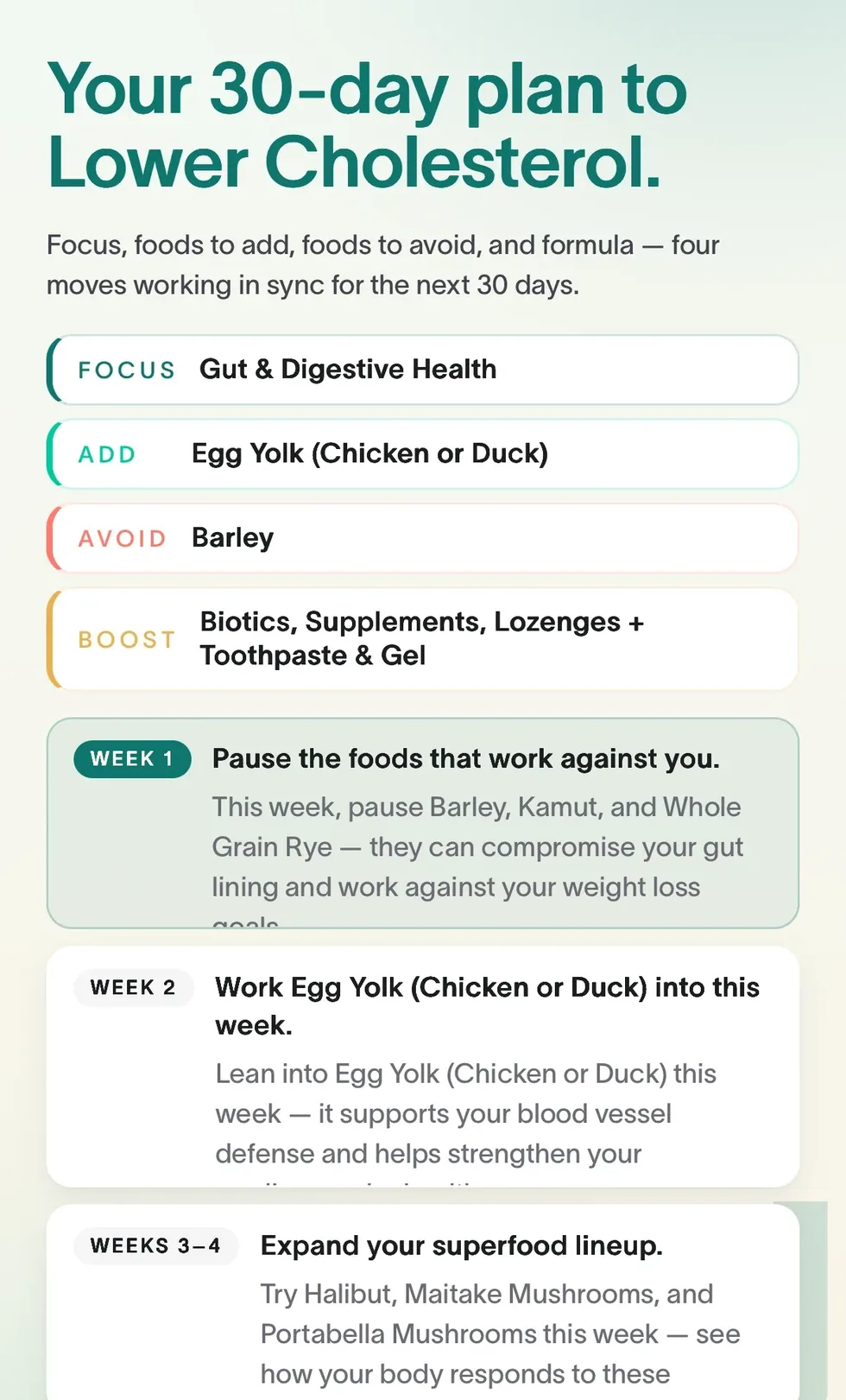
- Week one is subtraction only. Pause the specific grains working against the focus area. Nothing new to buy, nothing new to remember.
- Week two adds exactly one food. Not a menu. One item, with the reason attached, so you know what you are looking for when it works.
- Weeks three and four widen the bench with two or three more superfoods, framed as an experiment to see how you respond.
- The recipe engine does the assembly. Up to 3,000 recipes ranked against your own lists, with avoid foods excluded and each recipe labeled by how many of your foods it uses.
The order of operations
What the plan asks of you, in the order it asks for it.
That last point is what turns the whole thing into groceries, which is where members describe it landing.
What it looks like at the store
“These results have helped me to construct a grocery shopping list based largely on my superfoods and then enjoy foods, with only a very limited foray into minimize foods. I am already very food conscious as that is how I control my Type 2 Diabetes. Now I can knowledgeably refine my food intake even further.”
Joan R., verified buyer, Full Body Intelligence Test, April 2026
The plan is explicit about what food cannot do, which is a strange thing for a supplement company to publish
The formula screen does something unusually honest. For each ingredient in a personalized blend, it shows what you would have to eat to get the same dose from a plate.
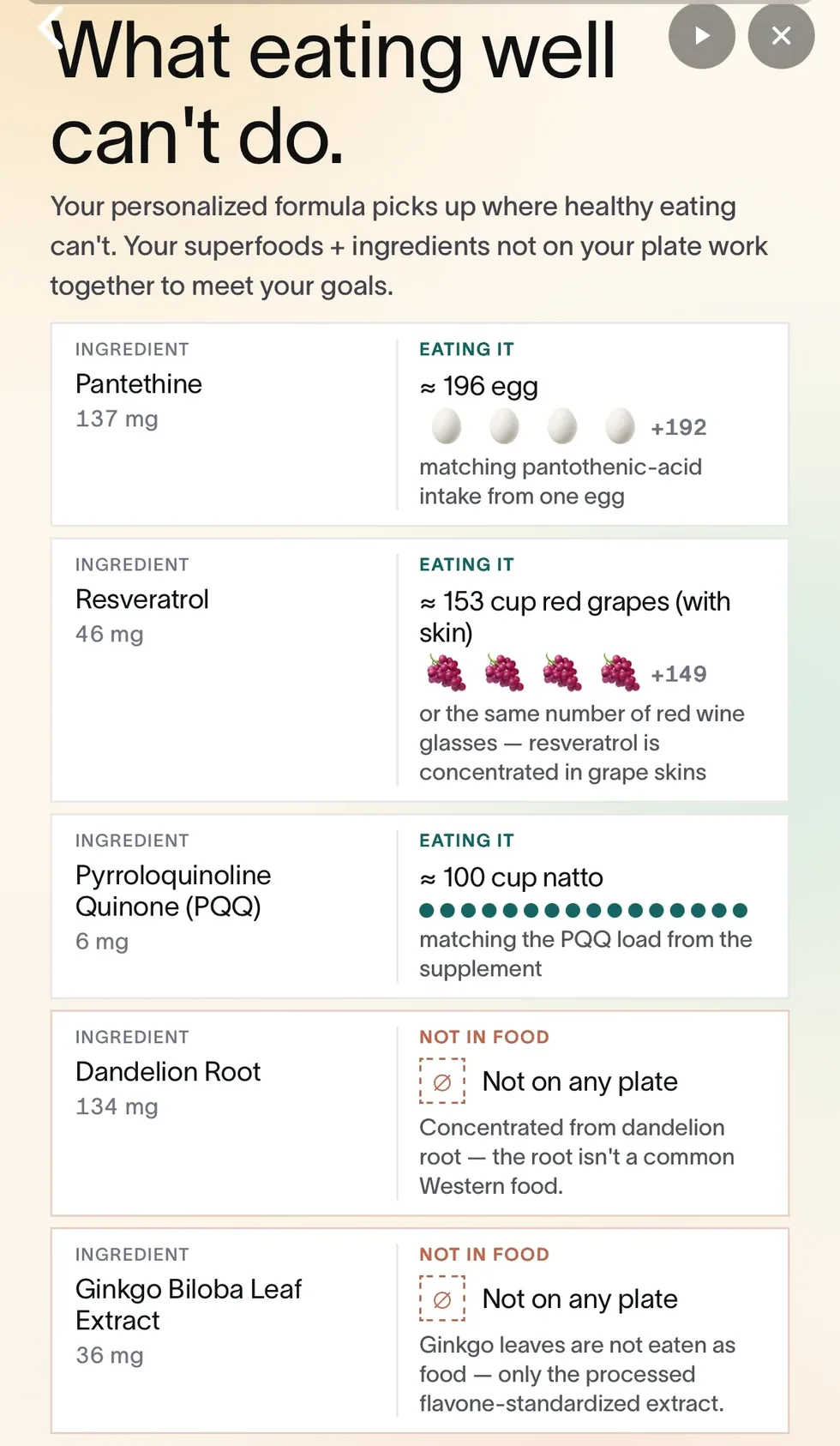
Viome's scientists pick from a portfolio of more than 200 ingredients and blend 50 or more into eight daily capsules, dosed against your scores and clinical trial dosages. The gut formula is built the same way, matching research backed strains and fibers such as apple pectin and guar gum to your specific microbiome, on the grounds that two people can react in opposite directions to the same probiotic.
Formula composition as published on viome.com. Personalized formulas are a separate subscription.
Two things worth knowing before you decide anything, both stated plainly by Viome. The personalized formulas are a separate subscription that starts after your results are released, and they are not included in the price of the test. And they are optional. Plenty of members run the food lists alone.
07 The part that annoys peopleA real plan will contradict something you believe, and that is the most common complaint about it
The most useful reviews Viome publishes are not the enthusiastic ones. They are the irritated ones, because they describe exactly what a personalized plan feels like when it disagrees with you.
The food list is good to know but it just seems like all the GOOD food I eat is on the bad list! Not impressed at all. Who ever heard of peanuts being better for you than pistachios?
Sharlene W. · Full Body Intelligence Test · July 2026 Verified buyer
That reaction is the model doing its job, and Viome says so directly in their own writing on oxalates: foods that are generally considered healthy, spinach and kale among them, may not be healthy for you, depending on your microbiome's biochemical activity. The list is not a ruling on the food. It is a ruling on the pairing.
The second complaint is sharper and deserves a straight answer.
I took the test twice, about a year apart. What was a superfood last year, was in the Avoid or minimize category this year. Very confusing.
Nancy D. · Full Body Intelligence Test · November 2025 Verified buyer
It reads like an inconsistency. It is the design. The recommendations are computed from gene expression, which is what your microbes are doing this month, not from DNA, which does not move. Change what you eat for six months and the activity changes, so the sorting changes with it. That is why the app writes avoid as a six month instruction rather than a permanent one, and why Viome asks you to retest twice a year rather than framing the first result as a verdict.
A typical DNA test reads
What you were born with
Fixed. Sequenced once, and the answer is the same in ten years.
Viome reads
What your microbes are doing
Gene expression, measured now. Change the inputs and the reading changes with them.
Distinction as Viome states it on their own product comparison, viome.com.
It also means the honest way to read a result is as a starting position. One member put six months between two tests and described the middle of it as the hard part, learning what her body responded to before she believed the numbers were hers at all.
08 What you actually buyTwo tests, one difference: how much of you gets read
Both kits are collected at home, in about twenty minutes, and mailed back prepaid to Viome's CLIA certified lab, where microbial activity is analyzed across more than 400 biological pathways. Results land in the app in roughly two weeks. Both are typically HSA and FSA eligible through Viome's partner Truemed, with a short survey at checkout producing the letter of medical necessity.
Gut Intelligence
Stool only
More than 25 health scores. Answers what your gut is doing.
Full Body Intelligence
Stool, saliva, blood
More than 70 health scores, plus oral health and biological age.
Figures published on the Full Body Intelligence product page, viome.com.

- More than 25 health scores across digestion, gut lining, inflammatory activity and microbial balance
- Personalized food lists and a personalized prebiotic and probiotic blend built from those scores
- Best fit if bloating, digestion or gut symptoms are the reason you are here

- More than 70 health scores, including biological age, inflammation and oral health
- 370 or more personalized food recommendations, drawn from more than 300,000 biomarkers analyzed
- Retest every six months so the lists move as your biology does
- Free US shipping, kit delivered in three to five business days
The difference between the two is not depth of gut analysis. It is breadth. Gut Intelligence answers what your gut is doing. Full Body Intelligence adds oral and cellular data, which is what unlocks the wider score set and, according to members who have run both, a longer food list to work with.
09 What members say once the list arrivesFour accounts, all published on Viome's own product pages
I only stuck with my food list that was provided by Viome. Needless to say it was a hard change. Learning what was good for my body and what made me feel better took a month or two. Once I started to understand how my body was responding, I started to believe my results were truly real.
Connie C. · Full Body Intelligence Test · August 2026 Verified buyer
Upon getting my results I immediately used the food list to guide my eating. I ate only from the yes list. This was particularly challenging because I am vegan, so my list was even shorter. However, my stomach issues immediately ceased causing my motivation to skyrocket. I have slowly added some of the minimize items to my diet with good result.
Shari H. · Full Body Intelligence Test · July 2026 Verified buyer
I have been especially trying to focus on my Super Foods, many that have not been in my diet regularly or ever. Aloe Vera Juice! It is NASTY, but I mix it with something tastier. I am following the avoid foods list. My digestive system is doing better.
Ann K. · Full Body Intelligence Test · April 2026 Verified buyer
The food categories, and how they affect my health, make choosing the right foods easy. But the recipes! I love how the recipes make it so easy to incorporate my foods into meals. They also label how many foods are being used from each category.
Linda T. · Full Body Intelligence Test · January 2026 Verified buyer
Reviews are published publicly on viome.com and belong to their authors. Quotations are trimmed for length and spelling only, never for meaning. Individual results vary.
Questions people ask before ordering
Which test should I choose?
Viome's own answer: Gut Intelligence if digestion, bloating or gut symptoms are the priority, Full Body Intelligence if you want the complete picture including cellular and oral health and biological age.
How accurate is it?
Samples are analyzed in Viome's CLIA certified lab using metatranscriptomic sequencing, which measures microbial activity rather than presence. Viome describes this as a more accurate read than ancestry style microbiome tests.
How long does it take?
Kit in three to five business days, about twenty minutes to collect at home, prepaid return, results in the app in roughly two weeks.
Is it covered by insurance?
Not billed directly to insurance, but typically eligible for HSA and FSA reimbursement through Viome's partner Truemed. A short survey at checkout produces the letter of medical necessity.
Do I have to buy the supplements?
No. The personalized formulas are a separate subscription available after results are released, and they are not included with the test.
How often should I retest?
About every six months. Your biology changes, and the recommendations are recomputed to match where your body is now rather than where it was.