The dark half of the walking year
What a driver actually sees at 6 a.m.
Most of the year, the walk before work happens before sunrise. The arithmetic on the other side of the windshield is worse than it looks.
The alarm goes off in the dark. Leash, coffee, jacket, and twenty minutes later the two of you are on the shoulder of a road with no sidewalk, in the last stretch of night before the sky starts to turn.
It feels early. It does not feel dangerous. Nothing has ever happened.
Part of the reason it feels safe is that you can see perfectly well. Your eyes have been adapting since you left the house, the dog is four feet away, the road is empty. What you cannot check from where you are standing is the only thing that actually matters, which is whether the person coming around the bend can see either of you, and from how far back.
That question has been measured, repeatedly, on closed test tracks, with instrumented cars and volunteers pressing a button the moment they recognize a human being. The answers are public. They are also much worse than almost anyone walking a dog at six in the morning would guess.
1. The clock liesSix in the morning is not early. It is night.
The clock is a poor guide to whether it is dark outside, because the clock does not move and the sun does. And twice a year the clock jumps sideways on purpose.
So take the 6:00 a.m. walk and ask one plain question. On how many days of the year is the sun still below the horizon at that moment, local clock time, daylight saving included?
In Bend, Oregon, where Ruffwear has designed dog gear since 1994, the answer is 265 days out of 365. On 220 of those days the sun is more than six degrees below the horizon at six o'clock, which is the astronomical end of civil twilight and the practical beginning of needing a light.
Not one city on that list has a 6:00 a.m. walk that happens in daylight for most of the year. The best case, Boston, is dark at six on 237 days. The worst, Atlanta, sits on the far western edge of the Eastern time zone and is dark at six every single day of the year, June included.
The pre-work dog walk is not a winter problem with a two month season. In most of the country it is a nine month problem, and the two weeks that make people notice it are only the two weeks after the clocks change.
2. The gapEight out of ten cars cannot light the road they are driving on
In May 2015, AAA put headlights on an unlit test track and measured two things: how far down the road each type actually throws usable light, and the distance a driver needs in order to identify an object, react, and come to a stop.
The finding has nothing to do with the person walking, which is what makes it so hard to argue with. Halogen headlights, which AAA found in over 80 percent of vehicles on the road, in their words "may fail to safely illuminate unlit roadways at speeds as low as 40 mph."
Not 70. Forty.
Switching to high beams buys 28 percent more sight distance and moves the ceiling to 48 mph. The HID and LED headlights on newer cars throw light 25 percent further than halogen, which still leaves them short above 45 mph on low beam. Only advanced headlights on high beam reach 500 feet, and 500 feet is the distance AAA equates with 55 mph. Even those, AAA noted, fall 60 percent short of what full daylight gives you.
Why the high beam column does not help
Every number above that clears 45 mph is a high beam number. On a road with oncoming traffic, parked cars, or a house with a bedroom window facing the street, the high beams are off. The 40 mph figure is the one that describes the road you are actually walking on.
Put the two facts side by side. A rural road posted at 45. Six in the morning. A car with halogen low beams, because that is what most cars have, and with the high beams off, because there is oncoming traffic. That driver is outrunning their own light, and has been doing it for years without ever finding out, because nothing has ever been standing in the gap.
3. Zero metersThe number that should end the argument
Knowing how far the light reaches is not the same as knowing how far a person can be recognized inside it. For that, the cleanest answer anyone has produced is a 2005 study in the journal Human Factors by Joanne Wood, Richard Tyrrell and Trent Carberry.
They put ten young drivers and ten older drivers on a closed road circuit at night and asked them to press a button the instant they recognized a pedestrian. They varied four clothing conditions and two beam settings, with and without glare from an oncoming car.
In the worst combination, low beams, black clothing, oncoming glare, drivers recognized 5 percent of the pedestrians. Ninety five out of a hundred were never seen at all.
And the mean recognition distance for older drivers, on low beams, facing a person in black clothing, was 0.0 meters.
At the other end of that experiment, pedestrians wearing retroreflective material arranged to mark the moving joints of the body, on high beams, without glare, were recognized 100 percent of the time, at a mean distance of 220 meters. Seven hundred and twenty two feet.
Two honest caveats before this becomes a slogan
The 220 meter figure comes from retroreflective markings placed on the limbs, which is a different design from a reflective panel on a torso, and it was measured on high beams with no oncoming glare. Nobody should expect that number from a vest.
And the study is about people. A dog is shorter, closer to the ground, further out toward the dim edge of the beam pattern, and does not move like a human being. Not one item on that list makes the problem easier.
Why the dog is worse off than you are
A person walking has three advantages over the animal at the end of the leash, and none of them are obvious until you list them.
Height
Headlights are aimed low and biased to the right on purpose, so they do not blind oncoming traffic. A standing adult sits inside the bright core of that pattern. A dog at knee height, on the far side of a leash, is usually in the outer, dimmer, poorly defined edge of it.
Gait
The whole reason limb markings work so well is a phenomenon called biological motion: the human visual system identifies a walking human from the pattern of moving joints long before it resolves the shape or the face. A four legged animal trotting at the edge of the light does not trigger it. The driver has to recognize an object, which is slower and far less reliable.
Color
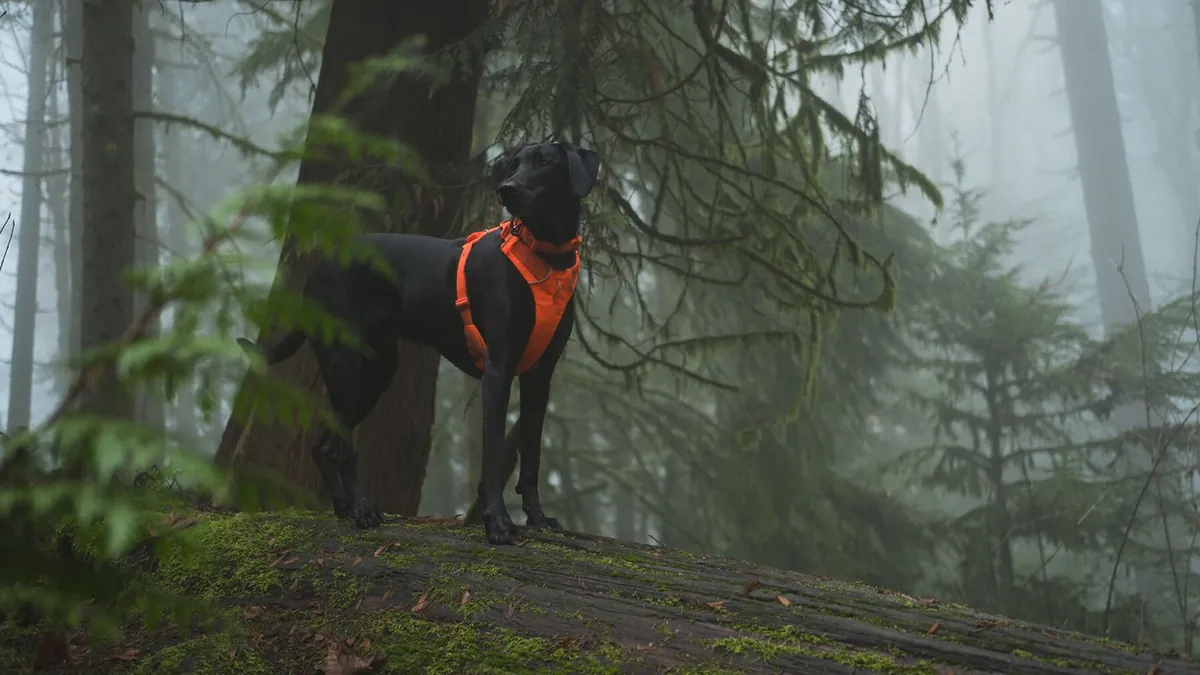
In the 8,000 most recent public reviews on ruffwear.com, 71 people volunteer, unprompted, that their dog is black or dark. They are not describing the coat for the fun of it. They are explaining why they bought the thing.
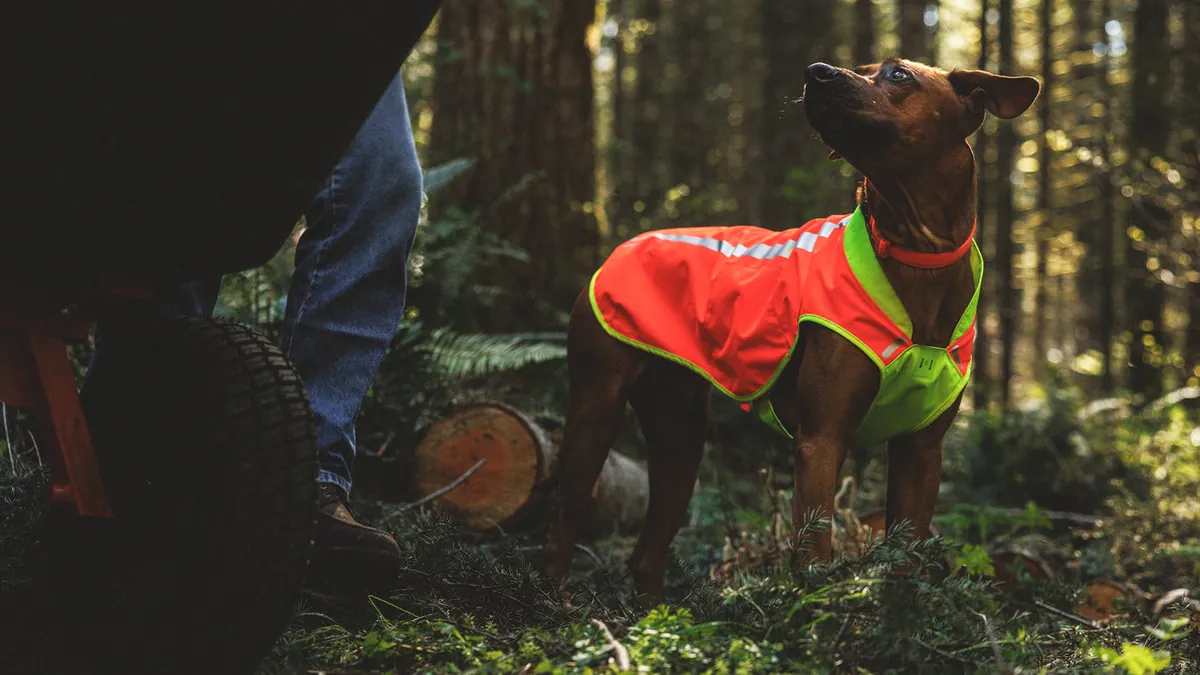
"He's a black dog, and we live on a street with few streetlights and no sidewalks, so I feel much safer walking him at night now that he's wearing this jacket."
Lauren S. · 4 stars · January 12, 2025 · verified buyer, Lumenglow vest
"I have a black dog so walking at night is obviously somewhat dangerous, this makes us clearly visible for early morning and late night runs/walks. Also when we go camping and he has to go potty, it's super easy on and off, and I can see him FAR with minimal light."
Kristan S. · 5 stars · May 21, 2025 · verified buyer, Lumenglow vest
Three kinds of dark, three different answers
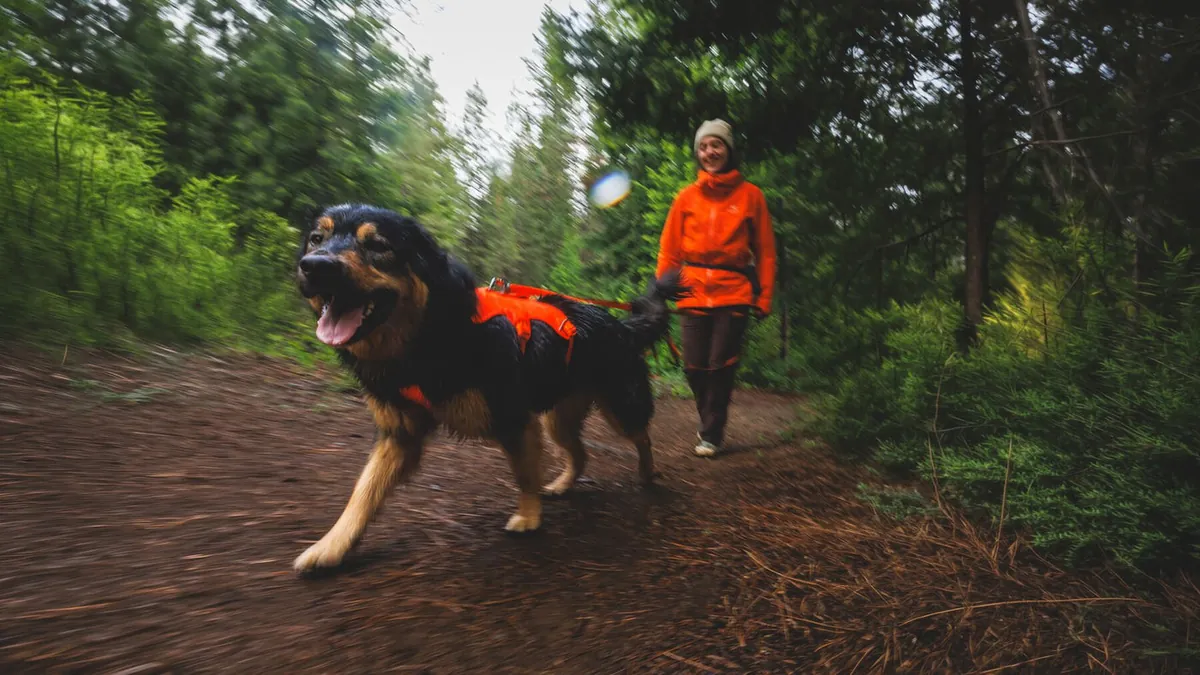
Most gear gets sold as "high visibility," as though visibility were one property, like waterproofing. It is not. There are three different lighting situations on a pre-dawn walk, and each one is solved by a different physical mechanism. A vest that handles one of them is not the same product as a vest that handles all three.
Ambient light, and nothing pointed at you
Dusk, dawn, heavy overcast, snow. There is enough light in the sky to see color, but not enough to see detail. What works here is contrast: a color that does not exist in the surroundings, at a saturation the eye locks onto. Blaze orange against grey asphalt and brown leaves is doing exactly the job it was invented for.
Full dark, with a headlight pointed at you
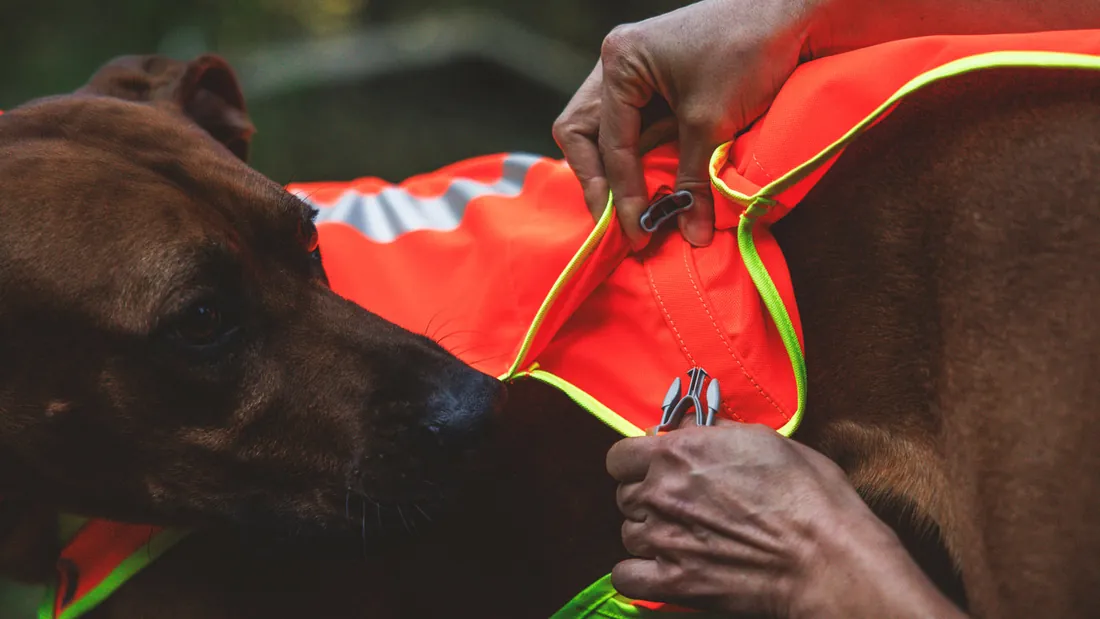
Now color is useless, because color requires light and there is none until the beam arrives. What works is retroreflection: a surface engineered to send incoming light straight back where it came from, instead of scattering it. That is the reflective print on a vest, the trim on a harness, the threads in a collar.
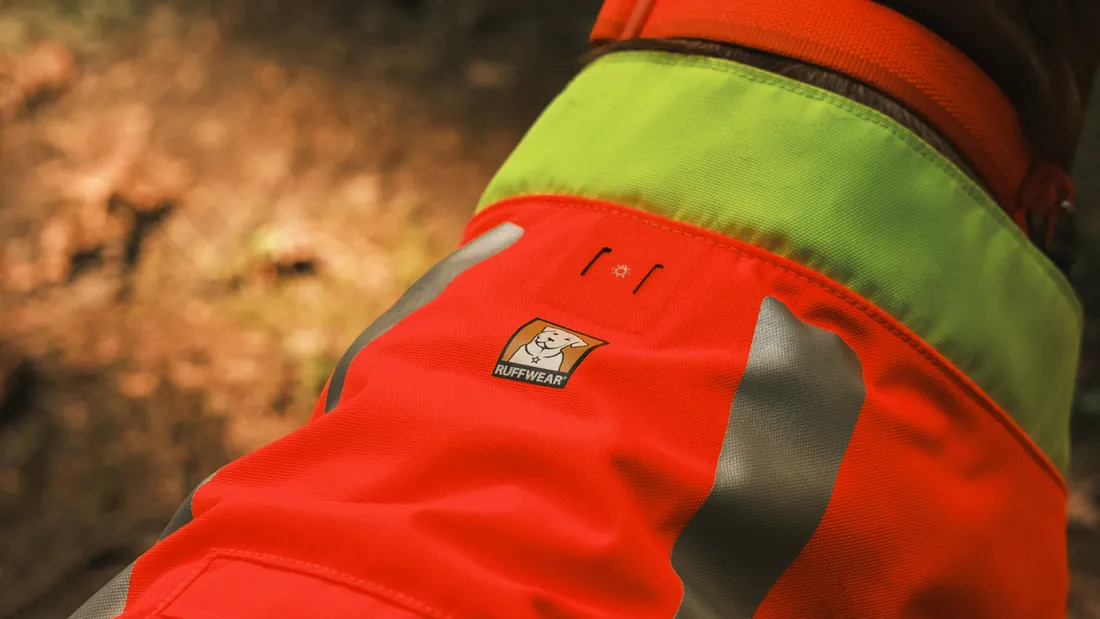
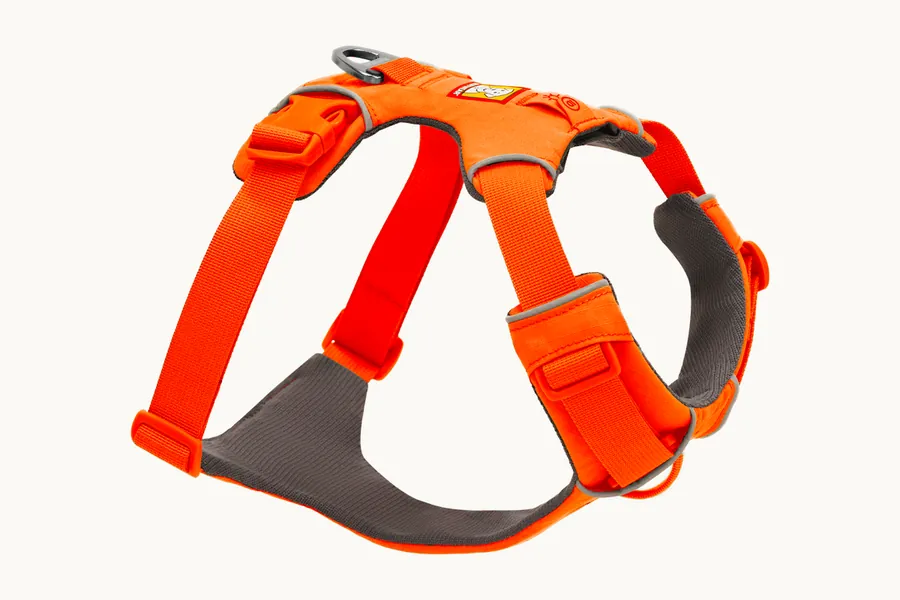
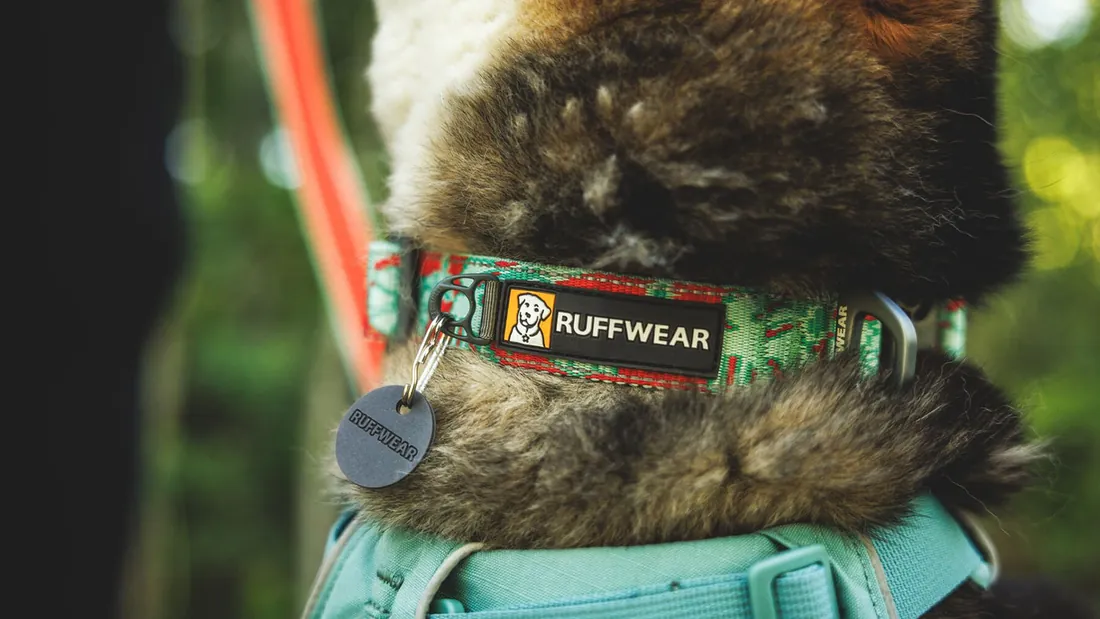
Three places the same physics is doing the same job. Photos: ruffwear.com
Full dark, with nothing pointed at you
This one is the gap nobody mentions, and it gets its own section below.
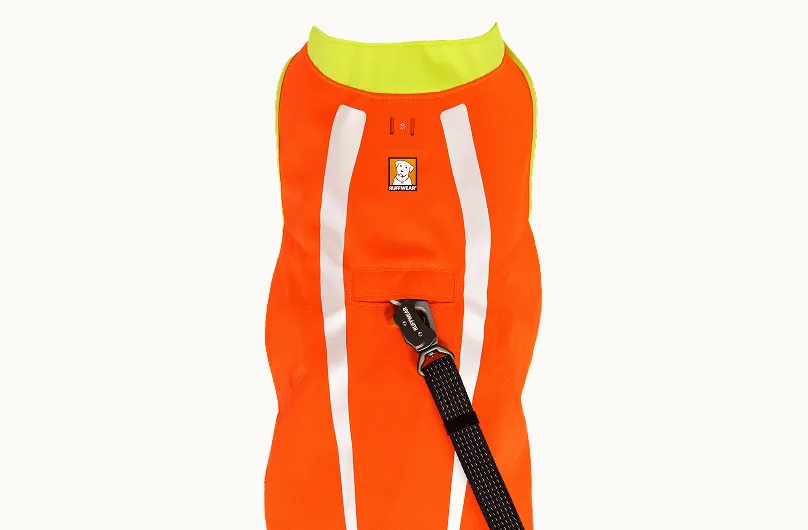
Ruffwear's Lumenglow vest is built to cover the first two columns in one garment. Their own description of it is unusually precise about the split: it combines "high-contrast color blocking (optimal for both day and night visibility) with bold reflective accents and two light loops for attaching the Beacon Safety Light." The feature list separates the jobs the same way, listing "Low Light Visibility: reflective panels create visibility in low light conditions" alongside "High-vis, high-contrast colors for visibility."
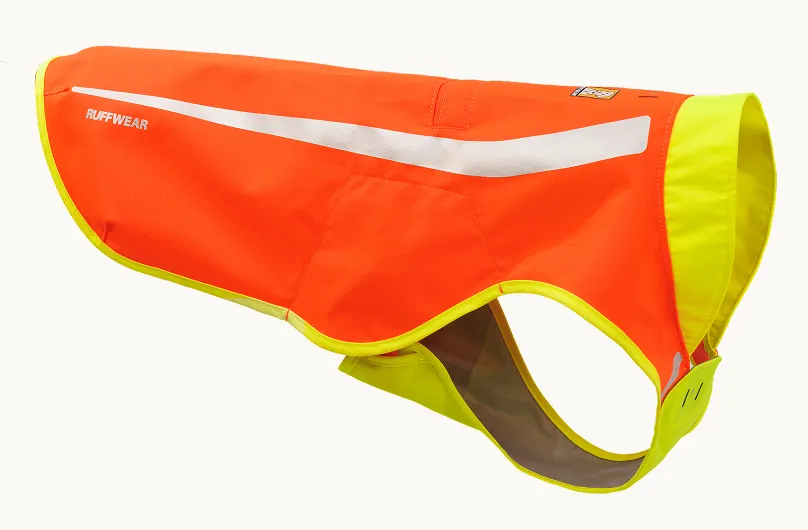
"What I especially like about it is that it both daylight and dark capable thanks to three nice and wide reflective strips along the body of the vest. In the daytime, it's definitely noticeable thanks to its bright colors. [...] Do drivers notice us now? Yes they do. Most will move over to give us a bit more room and smile and wave as they pass. The rare few even slow down."
Ron G. · 5 stars · November 19, 2024 · verified buyer, walking a Labrador five to eight miles a day
$59.99 · six sizes, XXS through XL · ruffwear.com
6. The gap in column threeThe catch with reflective trim that nobody prints on the label
Retroreflection is a beautiful piece of engineering and it has one hard limitation, built into the word itself. A retroreflector returns light to its source. It does not scatter light in all directions the way a white shirt does. It aims a narrow cone of light straight back along the path the light arrived on.
Which means a reflective panel makes your dog spectacular to exactly one observer: the person whose headlights are lighting it up, sitting a few degrees off the axis of their own beam. That is the driver approaching head on, and that is genuinely the most dangerous person on the road, so this is not a small win.
But consider everyone else on that same stretch of road at 6 a.m.
The cyclist coming the other way on an unlit greenway. The driver turning out of a side street, whose beams are pointed ninety degrees away from you for the two seconds that matter. The neighbor jogging toward you with a headlamp aimed at their own feet. Every one of them is looking at an object that, to them, is still black.
This is not a flaw in reflective gear. It is the reason serious visibility gear is built with somewhere to hang a light. The Lumenglow vest has two light loops, one on the back and one on the chest, which is a design decision that only makes sense once you have understood column three.
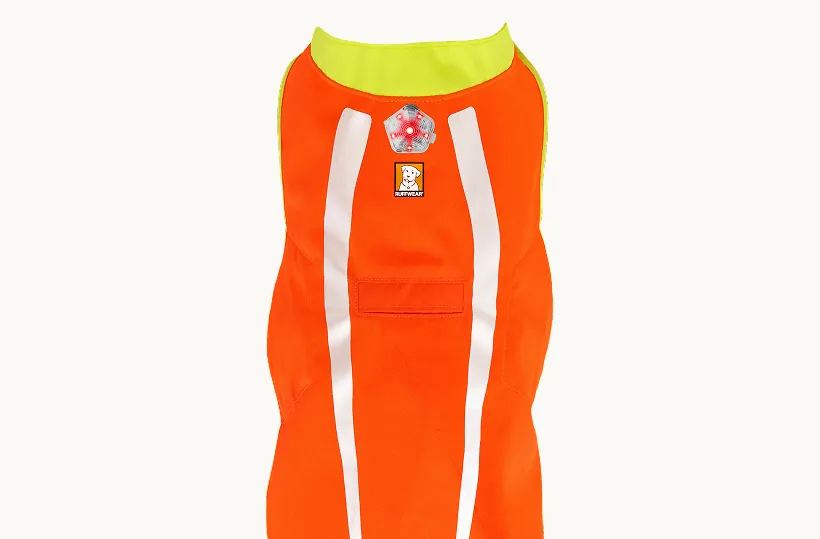
What goes on the loop
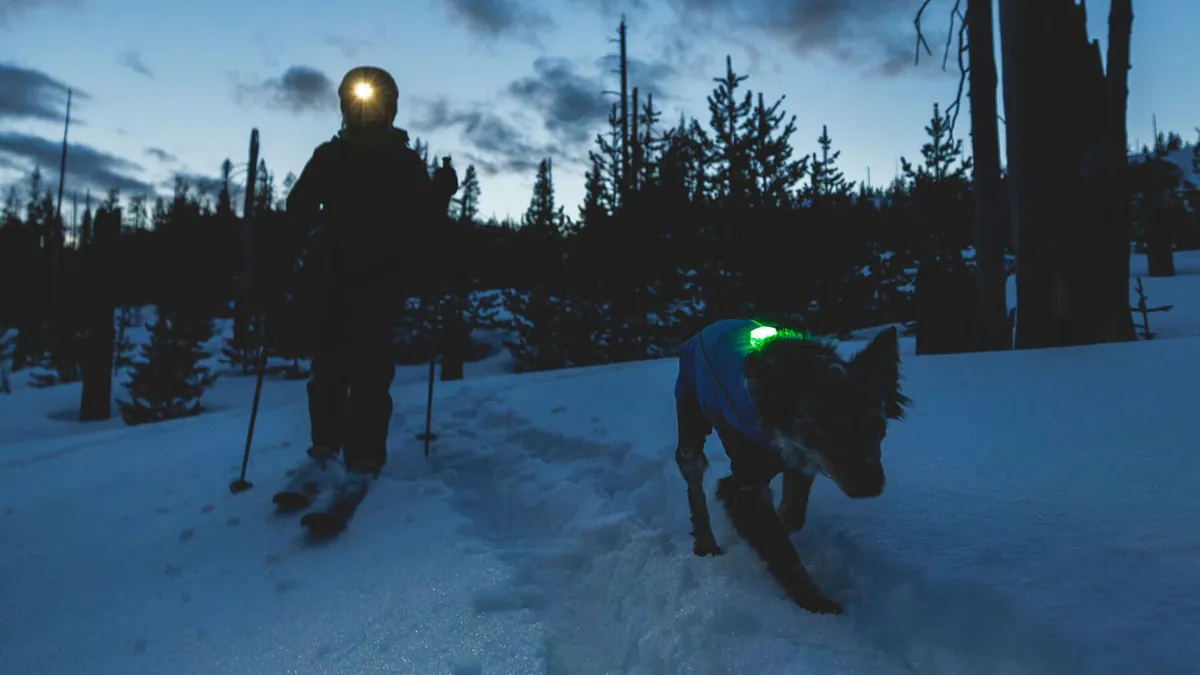
Ruffwear's own answer is The Beacon, a rechargeable clip-on light they describe as "visible from all directions with a bright, full-body glow design" thanks to a translucent shell that "exudes light from all angles." That phrasing is the whole point: it is not a spot pointed one way, it is a small omnidirectional source.
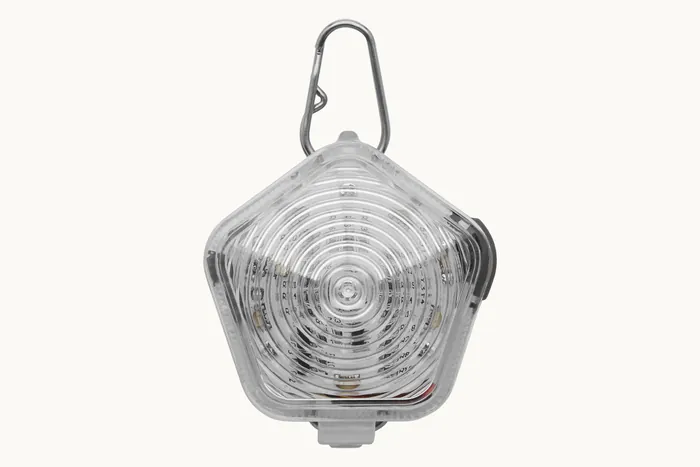
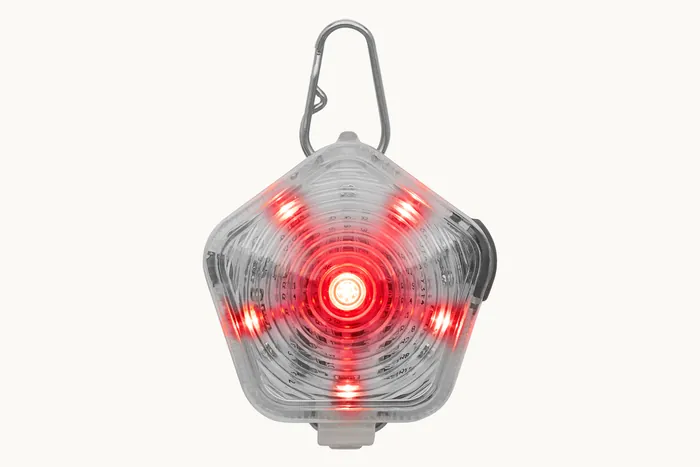
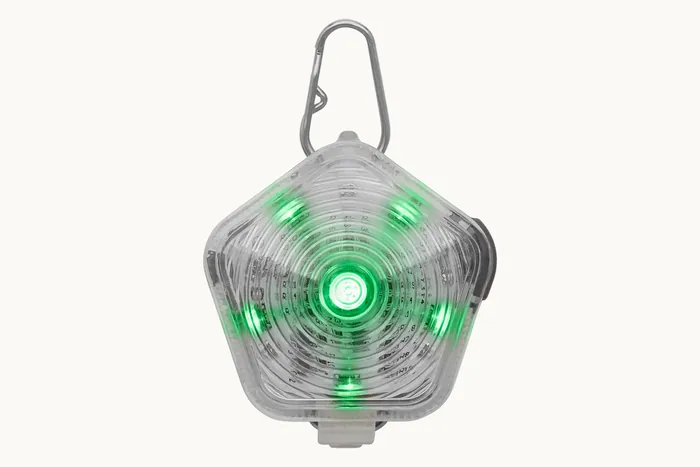
| Price | $39.99 |
|---|---|
| Runtime | Up to 20 hours, three colors, three modes |
| Modes | Slow Flash, Fast Flash, Always On |
| Battery | 280 mAh lithium polymer, recharges in about 1.5 hours by USB |
| Waterproof | To a depth of 1 m for 30 minutes |
| Attachment | Quick Clip, compatible with all Ruffwear collars and apparel light loops |
There is one review of that light that says more about the stakes than any specification does. It was written by a guide dog handler who is both blind and deaf, describing a route she and her dog Frisco run on Wednesday mornings.
"On Wednesdays when me and my Guide dog leaves our house at six in the morning it is still dark outside so that beacon safety light definitely helps frisco to be seen at night, where there's no street lights. [...] the light helps me because I'm not just blind. I'm also DEAF, so having a guide a dog and safety lights help so much for both of us to be safe and not get hit again by a car."
Rubii. Ineko G. · 5 stars · November 18, 2024 · verified buyer, The Beacon
Six in the morning. No street lights. And the phrase that stops you: not get hit again.
See The Beacon safety light$39.99 · clips to the vest's light loops · ruffwear.com
7. What owners write when nobody asksEight thousand reviews, and one theme that will not go away
Ruffwear publishes its customer reviews openly, with a public feed, so it is possible to read them in bulk instead of reading the four the page happens to show you. We pulled the 8,000 most recent, spanning November 2, 2024 to August 26, 2026, across 174 products, and read every one of them for a single question: what are people actually solving for?
Now narrow it to the light. The Beacon has 212 published reviews in that window. 110 of them, more than half, mention the dark, the night, dusk, dawn or low light by name. No other theme comes close on that product, and nobody prompted them: these are unstructured free-text reviews of a $39.99 accessory.
The reviews themselves are more specific than the counts. They keep describing the same three moments.
The moment the clocks change
"The suddenly dark after-work walks after the fall-back time change always catch us by surprise and have us scrambling to make ourselves visible with repurposed bike lights. This year I finally got this dedicated light to live on our dog harness and it is so much better!"
Dave R. · 5 stars · November 25, 2024 · verified buyer, The Beacon
The near miss
"We live in an area that's not well lit and we also go on trail walks at dusk and I feel much safer now. The other evening my dog got away from me when she saw a deer and she was not wearing the light at the time. We were by a busy street and could've easily been hit by a car. Thankfully she was ok. From now on I will always have the light on so she is more visible."
Yoko T. · 5 stars · December 9, 2024 · verified buyer, The Beacon
The one that reads like a product test
"I have used other high visibility jackets in the past and most have Velcro and made of fabric that collects dog hair and isn't easy to clean. This Lumenglow jacket looks great and keeps looking great as the fabric is shiny and cleans easily. It shows up in car headlights like no other! I have one for each of my dogs and use them for night walks this time of year and we use during hunting season in the Fall!"
Kathy B. · 5 stars · January 8, 2025 · verified buyer, Lumenglow vest
The other reason people buy blaze orange
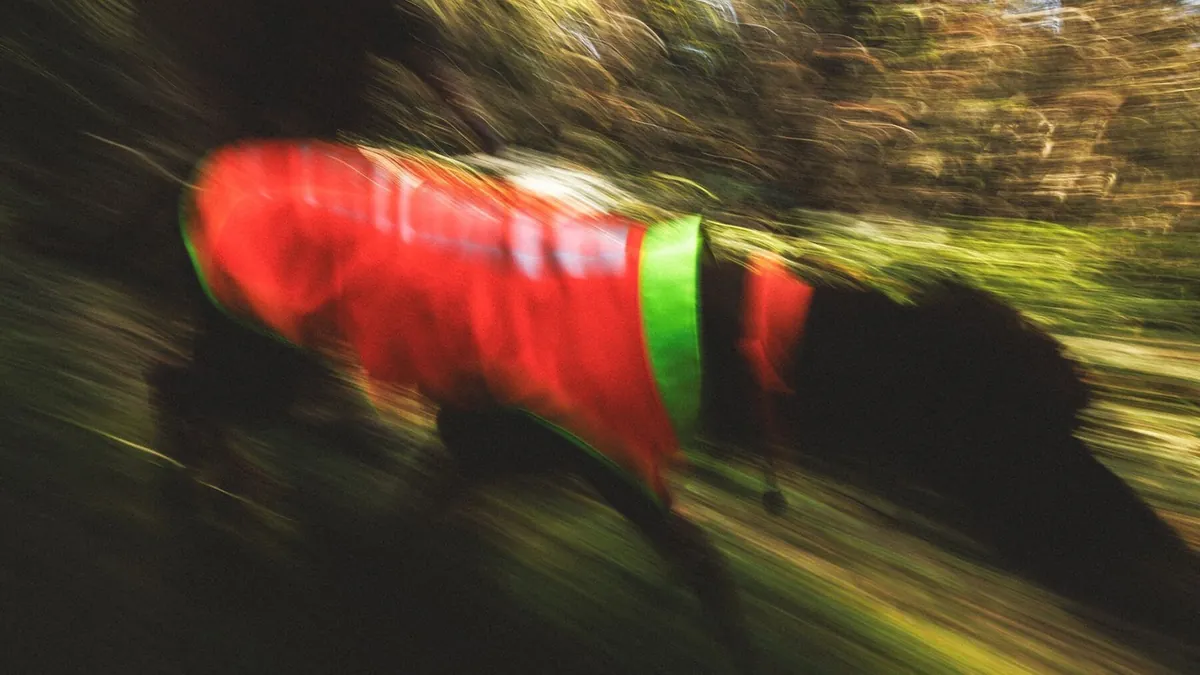
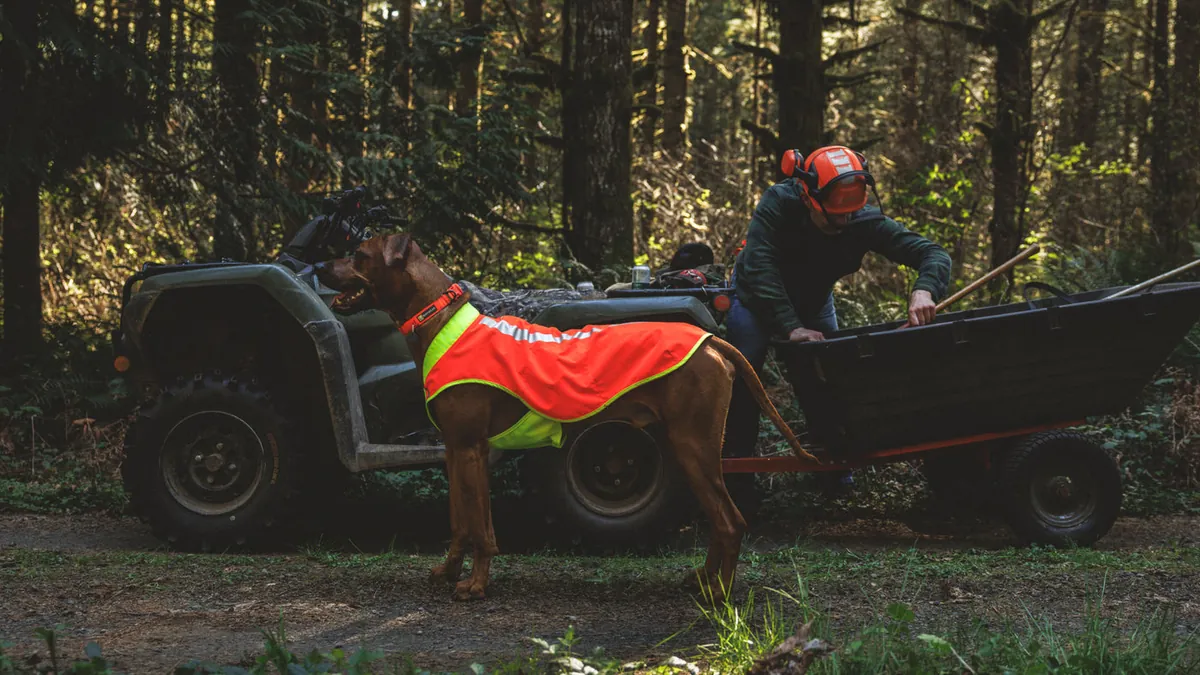
Something worth noting, because it changes what "high visibility" is for. Of the 110 published Lumenglow reviews, 29 mention hunting. That is more than one in four, and it is a completely different fear from traffic.
"I have a male Saint Bernard and a male Bernese Mountain Dog. We live in the middle of the forest where hunting is alive and well during certain seasons. My dogs are never on leash so these high visibility jackets give me the peace of mind that no one will mistake them for wildlife when hunting!"
Corie S. · 5 stars · November 5, 2024 · verified buyer, Lumenglow vest
The two seasons overlap almost perfectly. The weeks when the sun rises latest are the weeks when the woods are busiest, and blaze orange happens to be the answer to both, for the same underlying reason: it is a color that does not occur in a temperate landscape, so nothing in the visual field competes with it.
The one thing this vest gets criticized for
Reading 110 reviews of the same garment tells you what the buyers argue about, and on this one it is not the reflectivity, the color, the durability or the price. It is fit.
Sixty of the 110 reviews mention fit or sizing. More pointedly: of the eight reviews rated three stars or below, seven are about fit or sizing. Not one is about whether the vest works after dark.
"I ordered the medium for our 65 lb. golden retriever and it fits perfectly except the chest strap is too short by about two inches. I will have to modify it or return it. The large will be way too big everywhere else."
Dan · 3 stars · September 26, 2025 · verified buyer, Lumenglow vest
"The build quality and overall design is good as with all Ruffwear products we own. However, for a fluffy 'giant' sized breed (think Great Pyrenees, Newfoundland, Leonberger, etc...) the neck hole is pretty tight."
Henrik H. · 3 stars · December 22, 2025 · verified buyer, Lumenglow vest
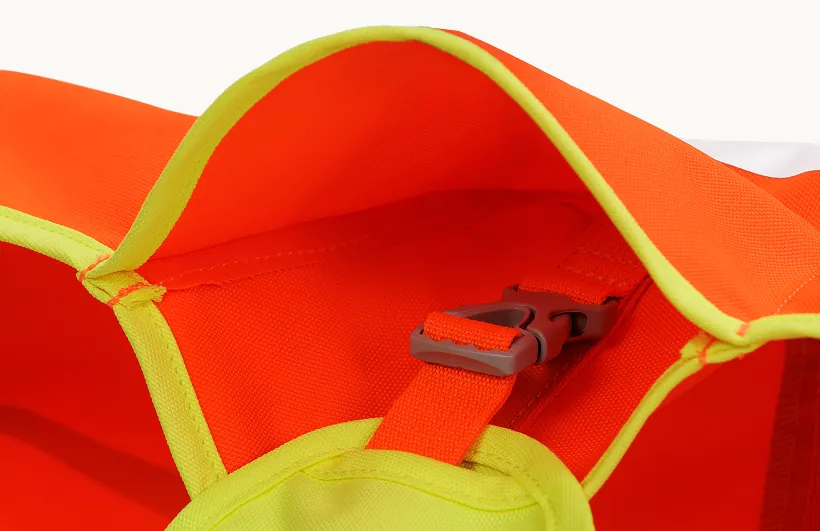
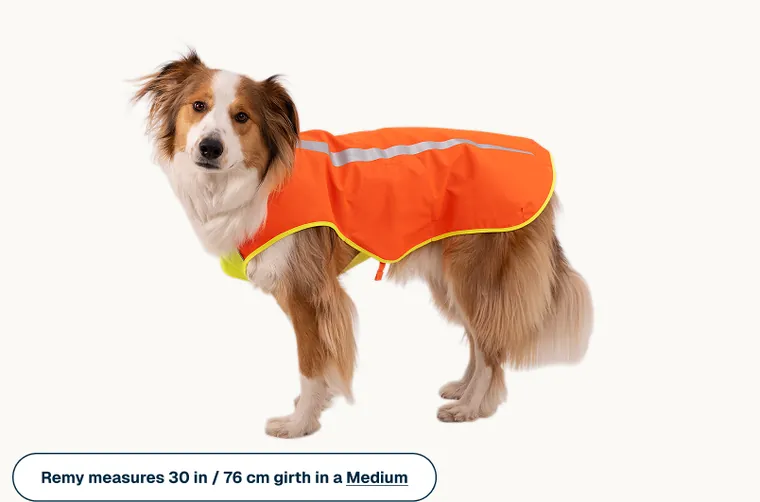
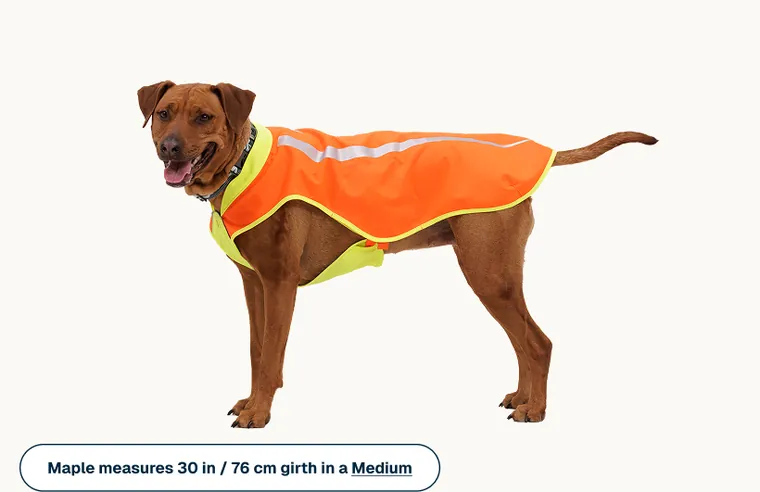
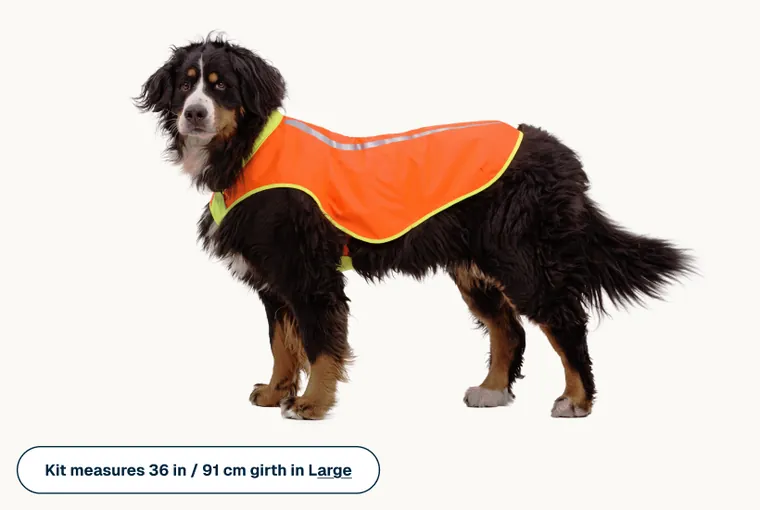
That is a useful thing to know before you order, and it is fixable in about ninety seconds with a soft tape measure. Ruffwear's current vest is built around a vest silhouette they describe as an "accommodating fit" that "suits a wide range of dog shapes and sizes, providing coverage over hips and thighs," closed with ITW Nexus Waveloc side-release buckles. Their sizing is driven by one measurement: chest girth, taken around the widest part of the rib cage.
| Size | Chest girth | Back measurement |
|---|---|---|
| XXS | 13 to 17 in (33 to 43 cm) | 10.5 to 14.5 in |
| XS | 17 to 22 in (43 to 56 cm) | 13.5 to 17.5 in |
| S | 22 to 27 in (56 to 69 cm) | 17 to 23 in |
| M | 27 to 32 in (69 to 81 cm) | 20 to 26 in |
| L | 32 to 36 in (81 to 91 cm) | 22 to 28 in |
| XL | 36 to 42 in (91 to 107 cm) | 26 to 32 in |
Ruffwear's own instruction for the in-between case is worth repeating verbatim, because it is the sentence most people skip: "If between sizes, size up for a more relaxed fit, or down for a more snug fit." Given that seven of the eight unhappy reviews are sizing reviews, it is the single highest-value sentence on the product page.
What to put on the dog tomorrow morning
The whole argument reduces to three sentences and one shopping decision.
One. The walk before work happens in the dark for two thirds to all of the year, depending on where you live, and the clock hides that from you because it does not move with the sun.
Two. The driver coming toward you is very probably outrunning their own headlights, because most cars have halogen low beams and those run out at 40 mph on an unlit road. That is a fact about their car, not about their attention, and no amount of you being careful changes it.
Three. The only two things that reliably move recognition distance are a surface that returns their beam, and a source that does not wait for a beam at all. Color helps at dusk. It does nothing at 6 a.m. in December.
| Price | $59.99 |
|---|---|
| Sizes | XXS to XL, sized on chest girth, 13 to 42 in |
| Color | Blaze Orange, with high-vis trim |
| Visibility | High-contrast color blocking, reflective screen print, two light loops (back and chest) |
| Shell | 600 denier polyester, PFAS-free water repellent finish, bluesign approved |
| Straps | 100% recycled polyester webbing, ITW Nexus Waveloc side-release buckles |
| Harness | Back leash portal, compatible with most harnesses |
| Care | Cold water, gentle cycle, mild detergent, hang to dry |
| Made in | Vietnam |
Buy for the column you are actually walking in. If your walks are at dusk on lit streets, the color alone is doing most of the work. If they start before civil twilight on a road with a 45 mph limit, you want the reflective layer and something on at least one of those two loops.
$59.99 · ruffwear.com · designed in Bend, Oregon since 1994
Sources
- AAA, AAA Tests Shine High-Beam on Headlight Limitations, May 13, 2015. Halogen headlights in over 80 percent of vehicles; low beams "may fail to safely illuminate unlit roadways at speeds as low as 40 mph"; halogen high beams improve sight distance by 28 percent and allow safe stopping up to 48 mph; HID and LED illuminate 25 percent further and may fail above 45 mph on low beam; advanced high beams light up to 500 feet, equal to 55 mph; all fall 60 percent short of daylight. newsroom.aaa.com
- Wood, J. M., Tyrrell, R. A., and Carberry, T. P., Limitations in Drivers' Ability to Recognize Pedestrians at Night, Human Factors 47(3), 2005, pages 644 to 653. Recognition of 5 percent of pedestrians in black clothing on low beam with glare; 100 percent for retroreflective biological-motion clothing without glare; mean recognition distances from 0.0 m to 220 m. journals.sagepub.com
- Pedestrian and Bicycle Information Center, Facts and Statistics: Safety, citing NHTSA Fatality Analysis Reporting System, 2019 to 2023: "76.3 percent of pedestrian fatalities nationwide occur in dark conditions." pedbikeinfo.org
- Sunrise and civil twilight counts computed for this article using the NOAA solar position algorithm, for calendar year 2026, at each city's coordinates, applying United States daylight saving rules (second Sunday in March to first Sunday in November). Bend, Oregon 44.0582 N, 121.3153 W. Validated against published tables: New York sunrise December 21, 2026 at 7:16 a.m. EST and June 21, 2026 at 5:25 a.m. EDT.
- Ruffwear, Lumenglow High-Vis Vest product page: description, feature list, materials, care, sizing chart and price, read August 27, 2026. ruffwear.com
- Ruffwear, The Beacon Dog Safety Light product page: description, feature list, battery, runtime, waterproof rating and price, read August 27, 2026. ruffwear.com
- Ruffwear, High-Visibility Dog Gear for Fall + Winter, published October 9, 2025. ruffwear.com
- Ruffwear public customer review feed: the 8,000 most recent reviews, November 2, 2024 to August 26, 2026, 174 products, mean rating 4.73, 83.6 percent five stars. Counts quoted in this article are word searches over that set. Reviews of the Lumenglow vest include both the current vest and the previous generation of the same name, as recorded in the feed.