Sleep Technology
The Thermostat Argument Nobody Wins
One bed, two people, one number on the wall. An engineer from the NASA spacesuit program says the number was never the problem.
Somewhere around two in the morning, one of you is going to move.
It is always the same choreography. A leg comes out from under the comforter. Then an arm. Then the whole comforter migrates to one side of the bed, and the other person surfaces just enough to feel cold, and pulls it back. Nobody says a word. You both go back to sleep slightly annoyed.
The negotiation gets conducted in daylight, in the language of the thermostat. Sixty-eight. Seventy-two. One of you says the house is a meat locker. The other says they cannot breathe. You settle on seventy, because seventy is the number that makes both of you equally wrong, and you have been calling that a compromise for years.
An HVAC technician who reviews his own bedroom equipment online put the problem in one line: "almost every couple is a hot and a cold sleeper." If that is true, and most couples will tell you it is, then the argument was never really about the number.
The argument has a bad premise
Why there is no correct number
The fight assumes there is a right answer and that the two of you simply disagree about what it is. There is no right answer, for a reason that has nothing to do with either of you being difficult.
You are not sleeping in the room.
A thermostat samples open air on a wall, several feet away from the bed, at roughly chest height. It holds that air at whatever you asked for, and it does that job well. Then you climb into a bed and pull a comforter over yourself, and you build something the thermostat has no access to: a small, enclosed, humid pocket of air, warmed continuously by a body that does not stop producing heat when it falls asleep.
Eighteen inches away, your partner builds a second one. Different body, different metabolism, different bedding, different tolerance. Same duvet.
One dial. Two climates. The dial reaches neither of them.
The tell
If the thermostat really controlled how you sleep, the fix would be arithmetic. Move the number two degrees and the problem goes away. Instead, couples move the number for years and the same person keeps waking up sweating and the same person keeps waking up cold. That is the signature of a control loop pointed at the wrong thing.
Everything you have already tried
And the specific reason each one fails a couple
Most people arrive at this problem having already spent money on it. The fixes are all reasonable. They fail for the same structural reason: they act on the room, or they act on both of you at once.
| The fix | Why it does not settle it |
|---|---|
| Drop the AC | Cools the room, not the pocket of air under the comforter. The cold sleeper is now cold in the room as well as in the bed, and the house pays for it until morning. |
| Separate blankets | Ends the tug of war, which is real progress. It does nothing about temperature. The hot sleeper is still hot, now under a blanket of their own. |
| A fan on the bed | Pushes room air across whoever is in its path. In a shared bed, that is usually both of you, and only one of you asked. |
| A cooling pad or topper | Conditions the mattress surface from underneath. Plenty of people like the category. It normally means putting something between you and your mattress, and often water lines or wiring in the bed. |
| Separate rooms | The only one of these that reliably works. Also the one nobody wants, which is why you are still reading. |
Notice what none of these do. None of them treat the two halves of one bed as two different places.
The engineer who thought the setup was backwards
Newport, Rhode Island
Before he made anything for bedrooms, Mark Aramli was an engineer on the NASA spacesuit program. His customers were astronauts, and his part of the suit was the cooling and climate comfort system: the machinery that keeps a human being at a survivable, comfortable temperature inside a sealed envelope, in an environment that is actively trying to kill them.

He kept turning the same question over, and BedJet still publishes it in his own words on the company's about page:
"Why is it we can keep astronauts perfectly comfortable in outer space, the most hostile environment in the universe, and yet so many of us (including myself) aren't sleeping perfectly comfortable in our own beds!?"
Mark Aramli, founder, quoted on bedjet.comThe reframe is the entire product. Aramli did not try to build a better thermostat, and he did not try to build a better mattress. He built a small climate system for the inside of the bed, and left the room alone.
The first version was a prototype on his kitchen table. It went to Kickstarter and became the largest Kickstarter project ever to come out of Rhode Island. The company says it is now on its third generation of the machine and has sold more than 300,000 units. It is still based in Rhode Island, still family owned, and by its own description not a division of a multinational appliance company.
What the thing actually is
A climate system for the inside of a bed
It is easier to understand than most sleep gadgets, because there is nothing in the bed.
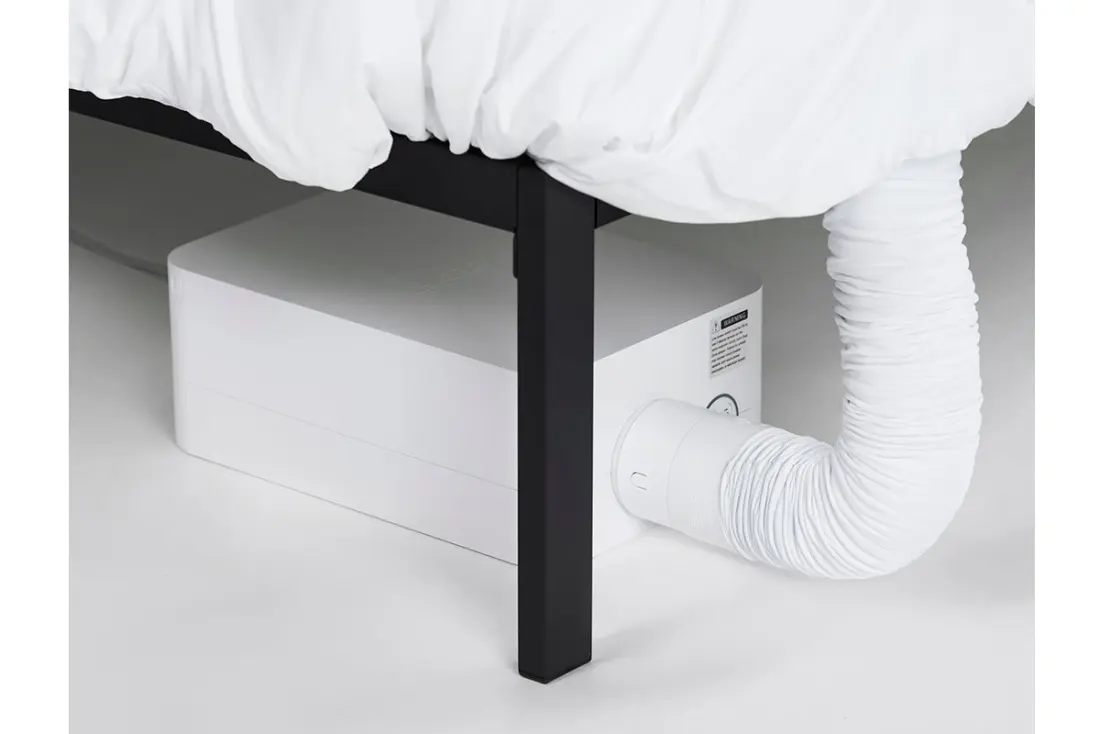
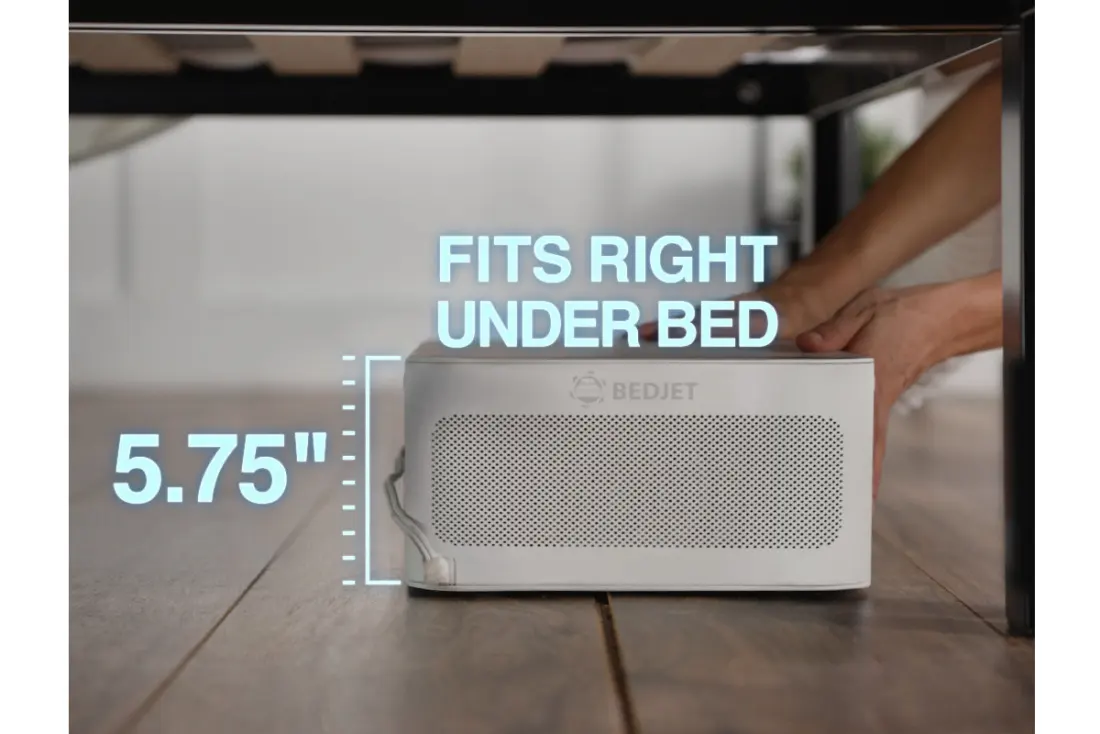
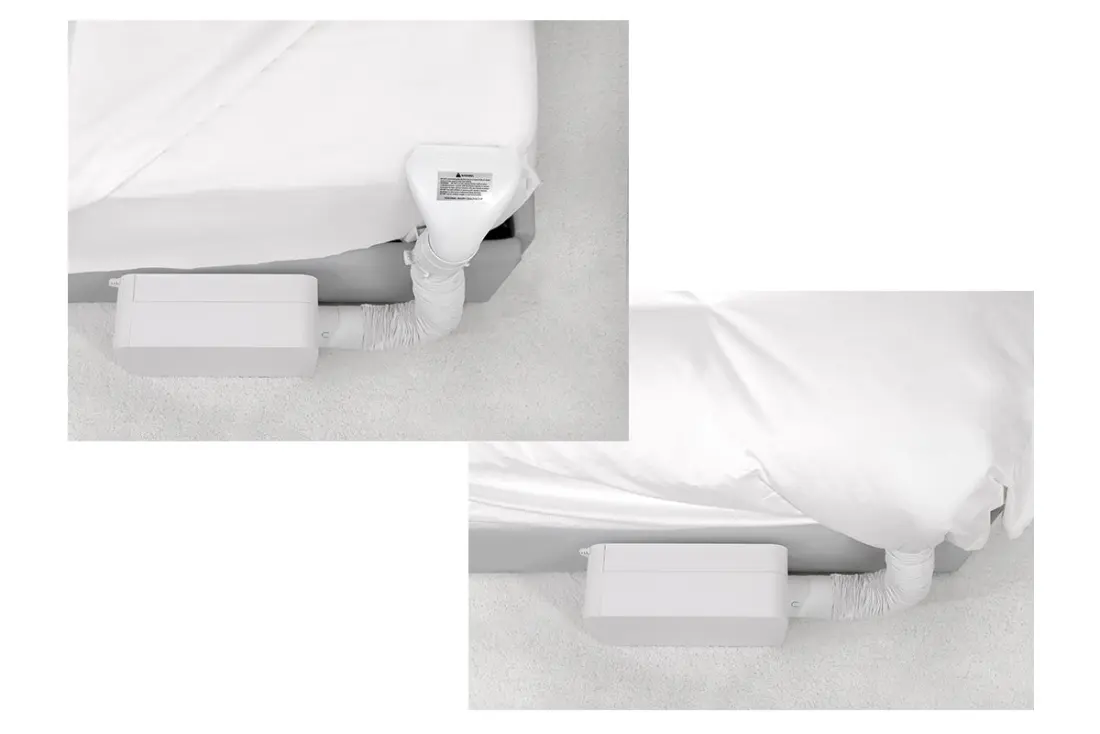
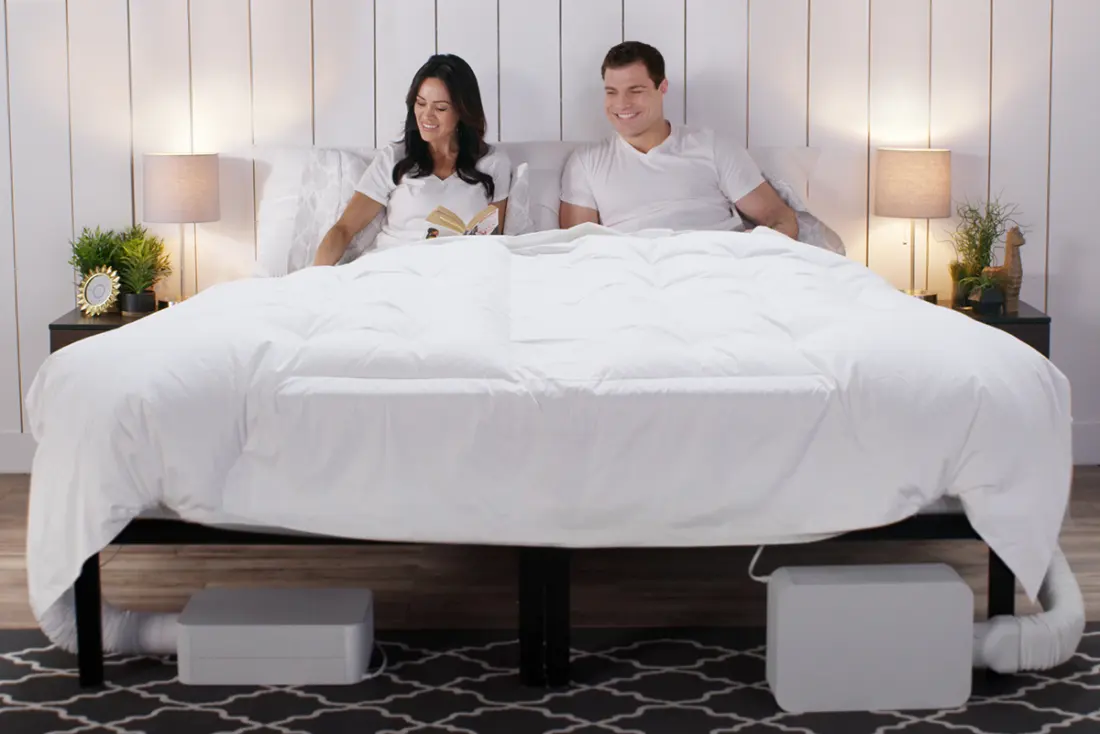
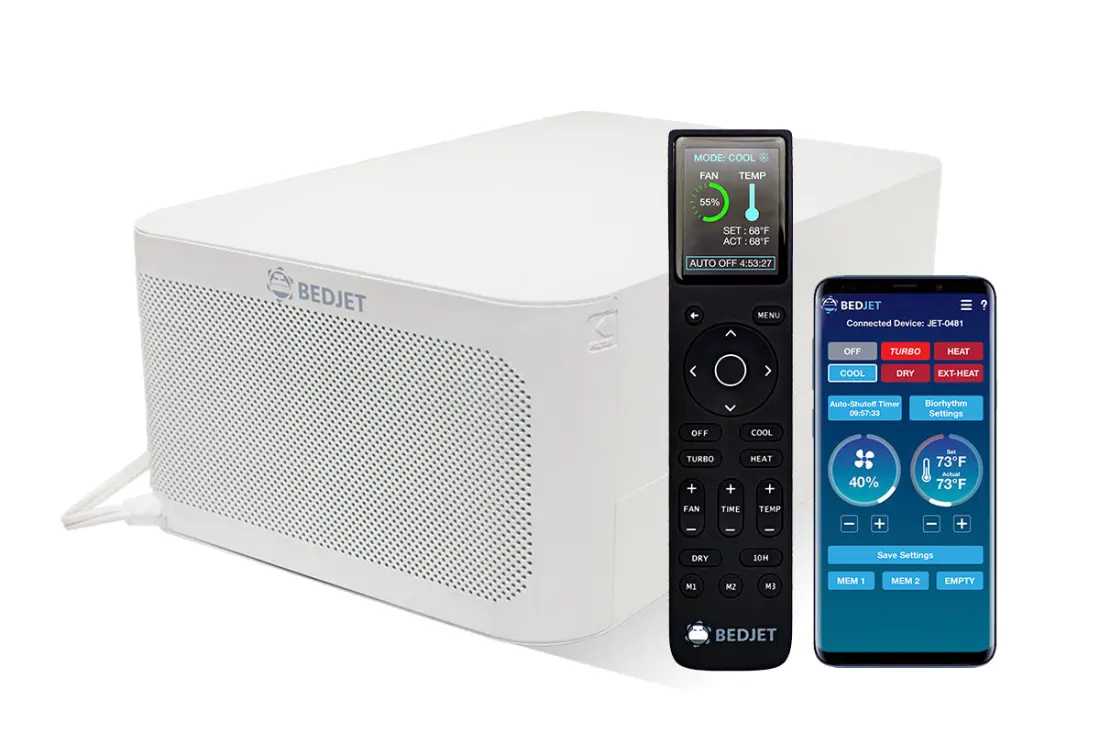
A small unit sits on the floor at the foot of the bed, or underneath it. A short hose runs from the unit up into your bedding, ending in a nozzle that clips into the sheets. The unit conditions air and pushes it into the space under your covers, where it displaces the trapped heat and moisture your body has been generating all night.
BedJet is emphatic about what that architecture avoids, and it is the sentence a lot of shoppers are actually looking for: "no wires, no tubes, no electricity in the bed and no mattress pads to sleep on top of, no water to leak." Your mattress stays the mattress you chose.
Published specifications
- Thermostat regulated from 66°F to 104°F, set by the degree. The company notes the lowest regulated temperature depends on the room it is standing in.
- Installs in minutes with no tools, and BedJet guarantees it works on any size bed, any brand of mattress and any type of bed frame, or your money back.
- 6 inches of clearance under the bed, 3.5 inches at the side rail. Power cord 6 feet, air hose 4 feet.
- Up to 40W in cooling. Heating draws 100W to 1,100W depending on the temperature you set, with a 1,500W turbo capped at 10 minutes.
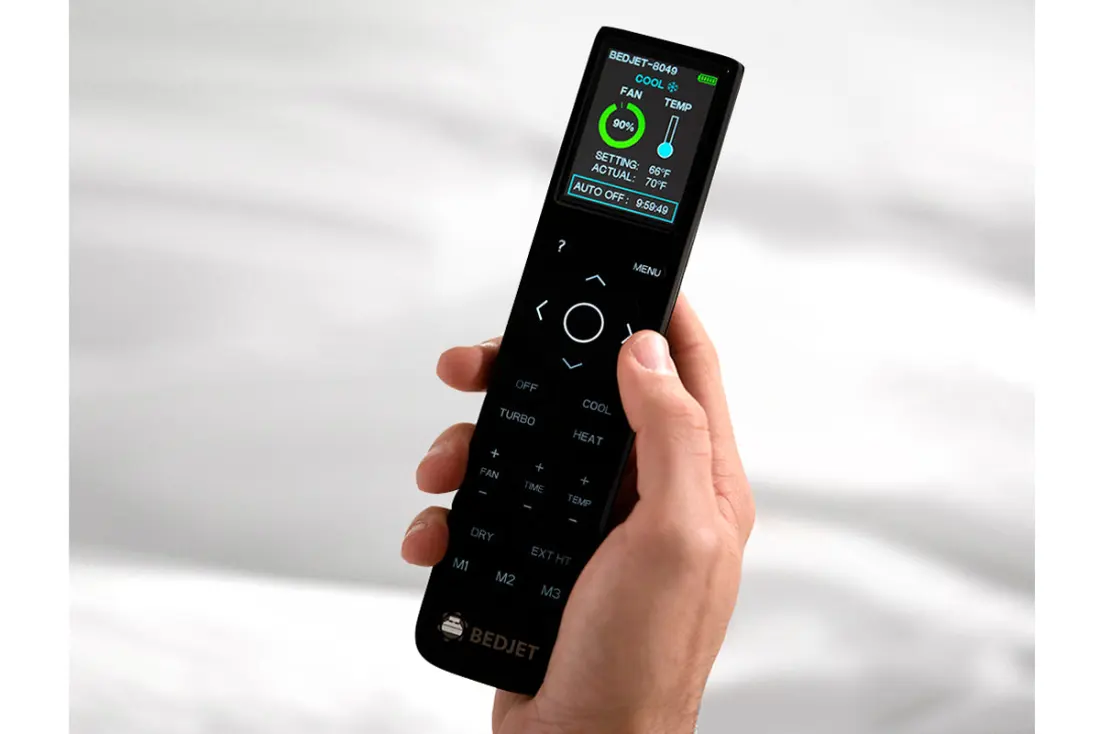
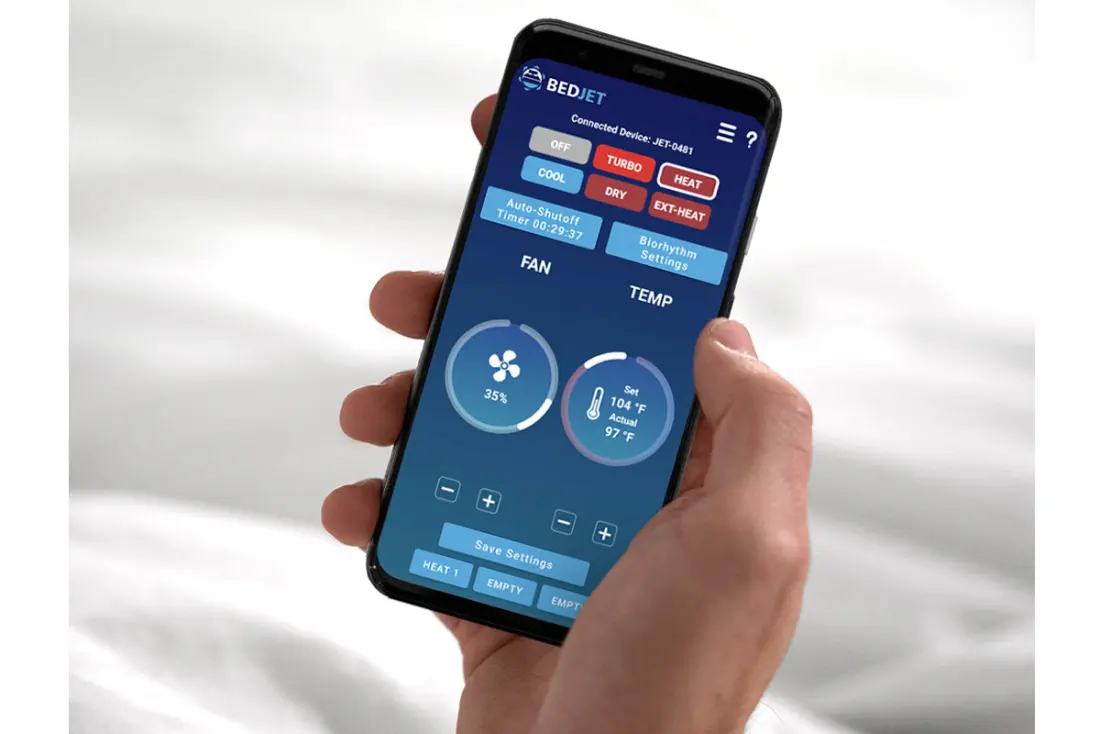
- Color screen remote for every function. The phone app is available over Bluetooth and WiFi but is not required, so the phone can stay off overnight.
- Biorhythm scheduling: program a different temperature for each hour of the night. BedJet says it was the first company to introduce it.
- ETL listed to UL Electric Appliance Safety Standards.
The sheet is the clever part
And it is the reason two zones are possible at all
Blowing air under a comforter is a blunt instrument. You get a cold spot where the nozzle is and nothing at your shoulders. BedJet's answer is a top sheet with plumbing sewn into it.
The Cloud Sheet is a 100 percent cotton top sheet with a series of interior air flow chambers. The nozzle plugs directly into it, and the chambers distribute the air evenly along the length of your body instead of dumping it at your feet. The company describes the effect well: with the unit running, the sheet "becomes wonderfully puffy and soft, just like your favorite down comforter, but instead of heavy feathers, the Cloud Sheet is filled only with conditioned BedJet air." Switch the unit off and it deflates into an ordinary top sheet. It goes in the wash with everything else.
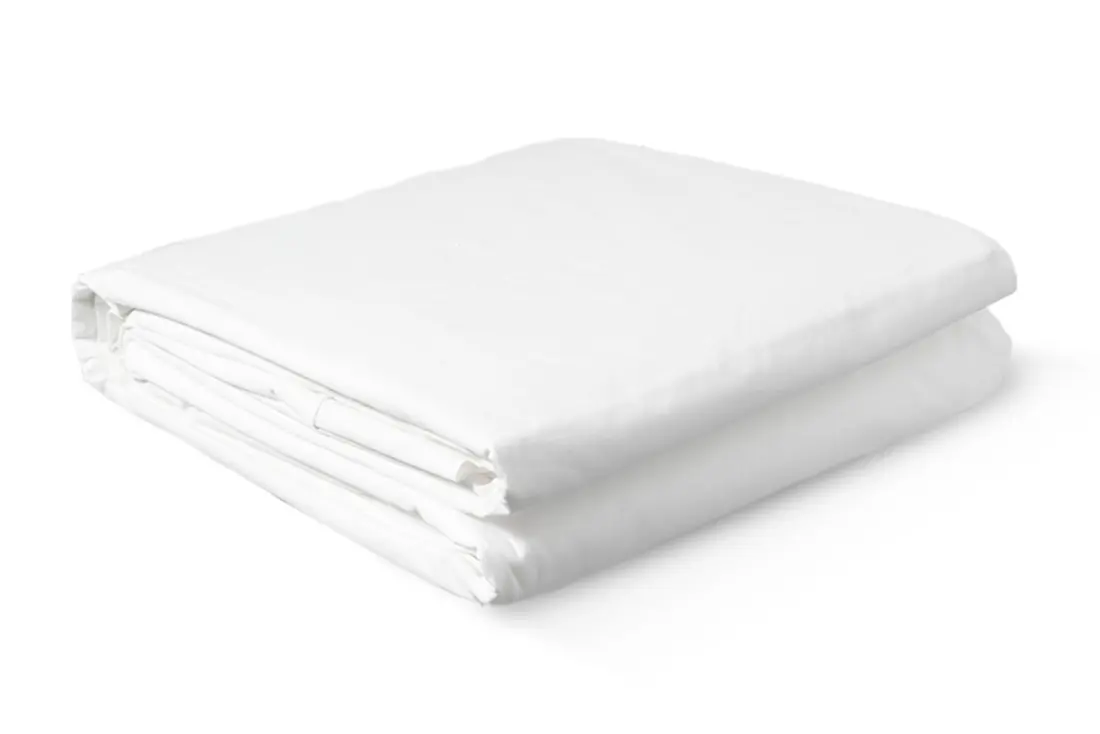
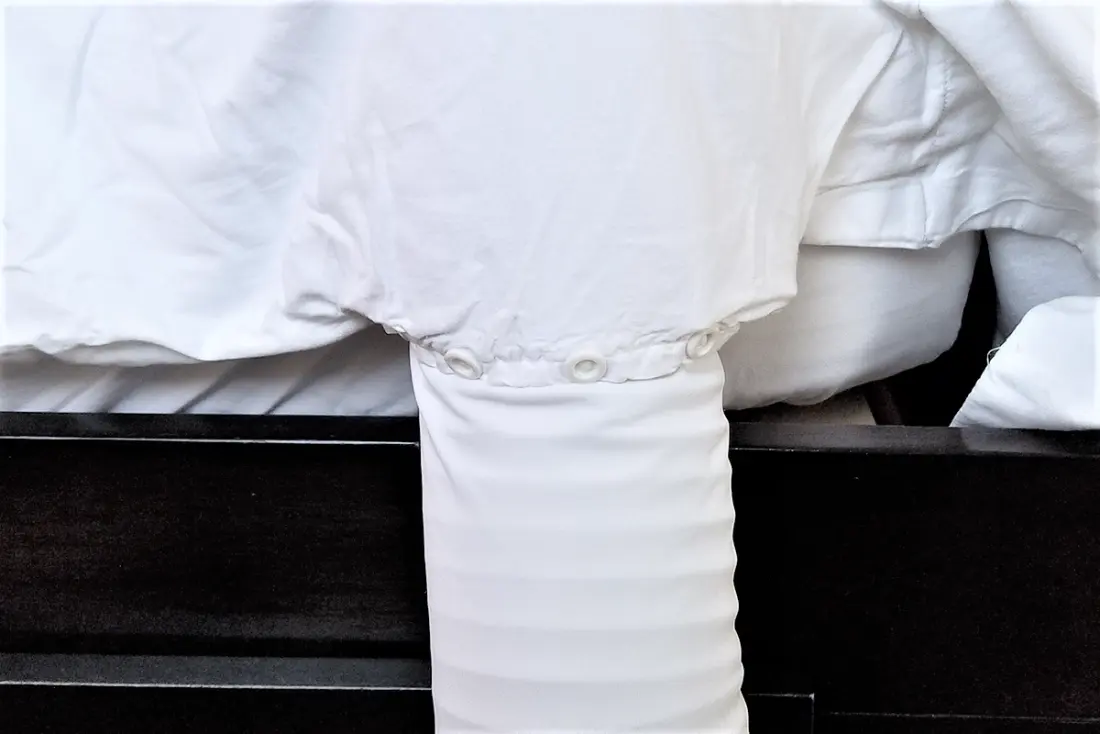
Now the interesting part. The sheet comes in two versions, and the difference between them is the whole answer to the argument you have been having.
And the objection everybody raises next, BedJet answers itself, in the same breath, on its own product page: "The only separation created by the Dual Zone Cloud Sheet is inside the sheet itself. There is no barrier between you and your partner!"
The division is in the plumbing. Not in the bed.
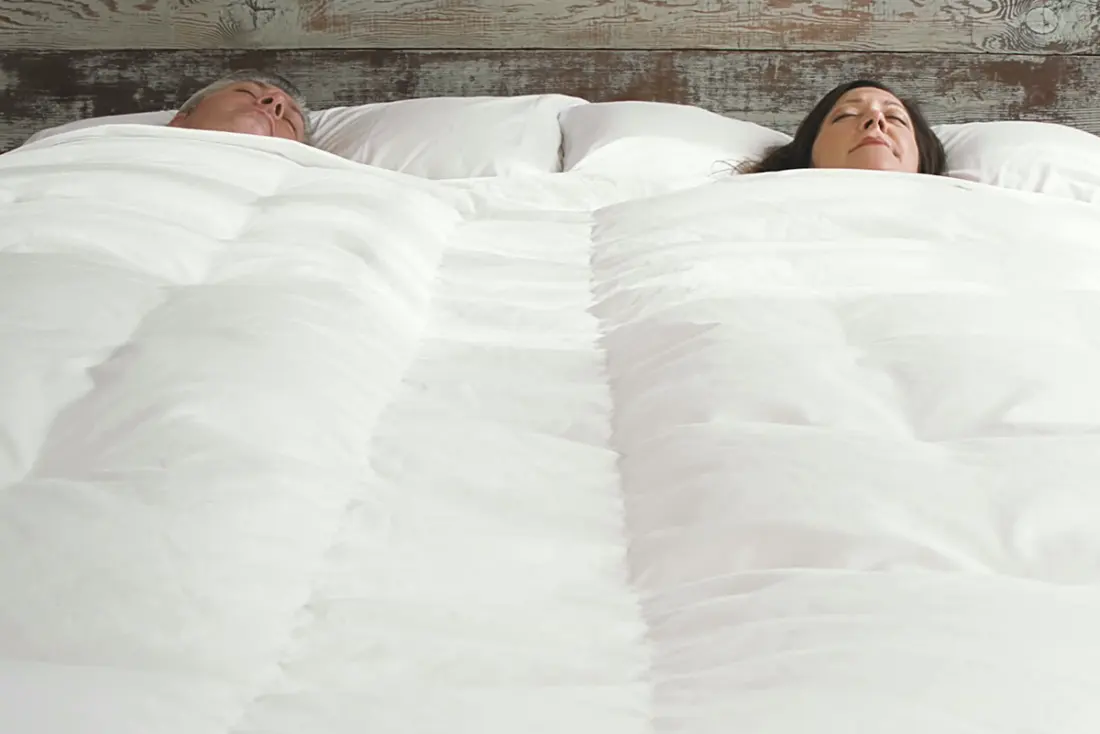
One bed, two settings
The Dual Zone system
The version built for couples is two machines and one divided sheet. BedJet lists what is in the box plainly: two BedJet 3 units with the attachment assembly, two color screen remote controls, and a Dual Zone Cloud Sheet. Each nozzle feeds its own chamber. Each remote drives its own machine.
Which means the extreme case is real, not marketing. One of you can run 104°F while the other runs 66°F, on the same night, under the same comforter, without either of you touching the wall.
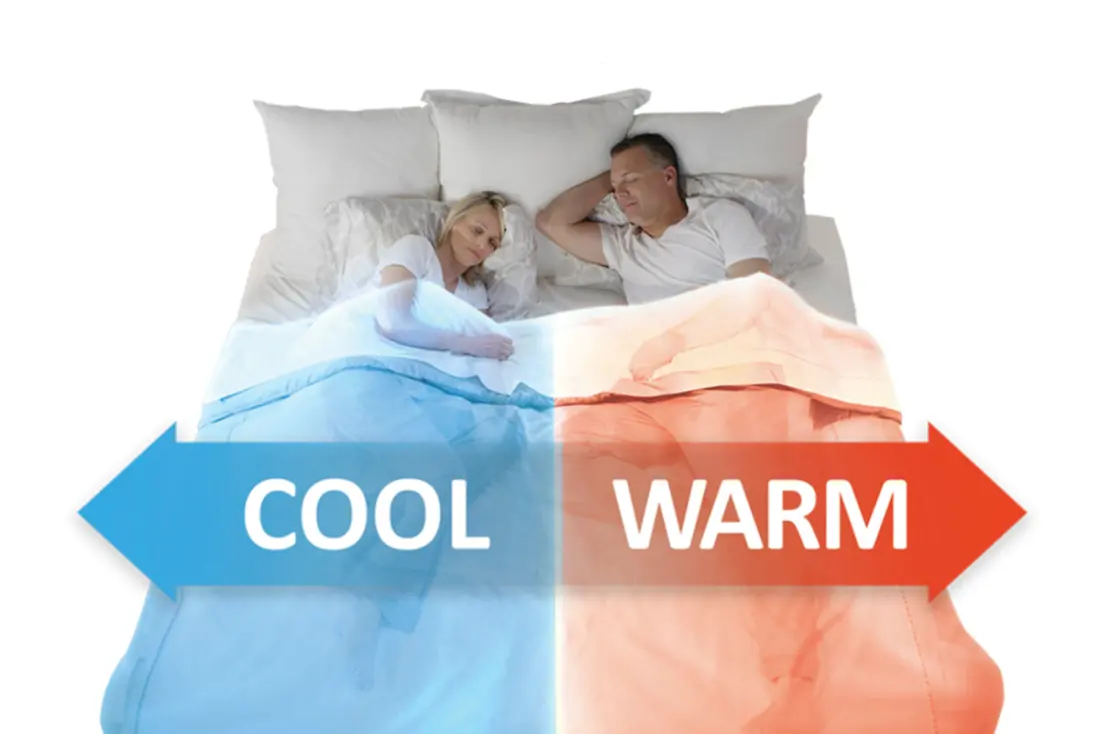
BedJet's own line for this product, on its own page, is not subtle about the fight it thinks it is ending: "Stop fighting over the thermostat with your partner and start sleeping better together."
See the Dual Zone system for couplesFree shipping in the US and Canada · 60 days of free returns · 2 year warranty
What couples actually report
Verified reviews published on bedjet.com
The reviews that matter for this problem are not the ones about better sleep in general. They are the ones written by two people who had already tried the thermostat.
"Let's start with the problem. She's hot and I'm cold in a 68 degree bedroom. Couldn't strike a balance with the HVAC. [...] The room stays at 68 and we each can control what air temperature hits our feet, legs and torso. All has been well. [...] There's not many items in my life that have made such a quality of life difference. This is one."
ANDREW M. · 5 stars · November 16, 2025 · verified review of the Dual Zone system on bedjet.com
"My wife and I love the BedJet! We've had it for about 5 years. Now we're spoiled and can't live without it. She likes it warm while I sweat at night. [...] I am an HVAC guy and I recommend them to everybody. They actually save you money because you don't need to turn the AC to way down at night anymore. Plus almost every couple is a hot and a cold sleeper. This is the best HVAC system for your bed!"
CHRIS M. · 5 stars · January 15, 2026 · verified review of the Dual Zone system on bedjet.com
"Honestly, I love this way more than I expected. My wife is generally cold, I'm typically hot. The setup was easy, the controls are simple, and the effect is amazing. If you are on the fence, its worth it!"
Timothy · 5 stars · July 22, 2026 · verified review of the Dual Zone system on bedjet.com
"This system has been a life changer for both me and my wife. I am a hot sleeper where is my wife sleeps cold. We purchased the bed jet for couples with the cloud sheets. I no longer sweat at night and I wake up feeling refreshed. The sheets used to be damp when I would wake up in the morning and this is no longer the case. [...] We live in Arizona where it is currently well into the 110s."
Kevin L. · 5 stars · June 17, 2026 · verified review of the Dual Zone system on bedjet.com
"I like to sleep warm and she likes to sleep cold and the cats like to sleep warm as well. The BedJet offers something for everyone. I wanted to give it a try, as my wife continually claims our bed is too hot. Lo and behold, the BedJet has solved that problem. Now, our only problem is getting the cats off of the warmer side of the bed."
Eric M. · 5 stars · March 17, 2026 · verified review of the Cloud Sheet on bedjet.com
"In the winter, I drop the house thermostat to 60°F and run the BedJet at 85°F. [...] What the BedJet really does is remove all that trapped heat, perspiration, and humidity under the sheets. It keeps a steady comfortable temperature all night long. You basically sleep dry."
Luke · 5 stars · November 12, 2025 · verified review titled "Perfect for Hot and Cold Sleepers" on bedjet.com
"Bought it for my husband and myself for a 45 year wedding anniversary! We both love it after the first night sleeping in it!"
Merle · 5 stars · April 13, 2026 · verified review of the Dual Zone system on bedjet.com
"Best sleep I've had as an adult 100%"
James · 5 stars · June 5, 2026 · verified review of the Dual Zone system on bedjet.com
Two themes repeat across them, and neither is the one the category usually sells. The first is that the room stays where the other person wants it. The second is dryness rather than cold: several owners describe the sheets no longer being damp in the morning, which is the part a fan pointed at the bed never fixed.
Where it does not work
Read this part before you buy anything
This is the section most product pages leave out, and it is the fastest way to know whether the thing is for you. All of it comes from BedJet's own published material and its own customer reviews.
Four honest limits
- A hot room beats it. BedJet says so plainly: it is not a replacement for air conditioning in extreme heat, "room temp needs to be below 79°F for best cooling," and above that "the extreme heat will overwhelm the convective cooling method." It conditions the bed. It does not condition the house.
- It is a fan, and you will hear it. BedJet calls it silky quiet airflow with patented acoustic damping. Owners describe it as white noise, and several say they like it. If any sound in the bedroom keeps you awake, that is a real consideration.
- The sheet is a top sheet. It is not fitted, and buyers regularly say they wish matching fitted sheets and pillowcases existed. Bought on its own it runs $139 to $169, which one reviewer called "a hard pill to swallow." It is included in the Dual Zone bundle.
- It is expensive. The company says so about itself: "we also understand that the BedJet is a luxury product." Two machines and a divided sheet is a real purchase, which is why the 60 day return window matters more than the marketing.
What it costs
Prices published on bedjet.com, August 13, 2026
One detail worth knowing if you are hesitating between the two: a Dual Zone Cloud Sheet works with a single machine too. Air flows through one half of the bed, and the other half behaves like an ordinary top sheet. If only one of you is the problem sleeper today, that is the cheaper way in, and you can add the second unit later.
The number on the wall was never the argument
What makes this problem so durable is that both people are right. One of you genuinely sleeps hot. The other genuinely sleeps cold. Neither is being difficult, and no single setting can serve both, because a single setting was always the wrong shape for the problem.
You have been trying to solve a two body problem with a one body instrument.
Set the room wherever the two of you can live during the evening. Then let each side of the bed have its own weather, and stop negotiating at two in the morning.
See the Dual Zone system for couplesOr start with a single BedJet 3 and a dual zone Cloud Sheet, and add the second unit later.